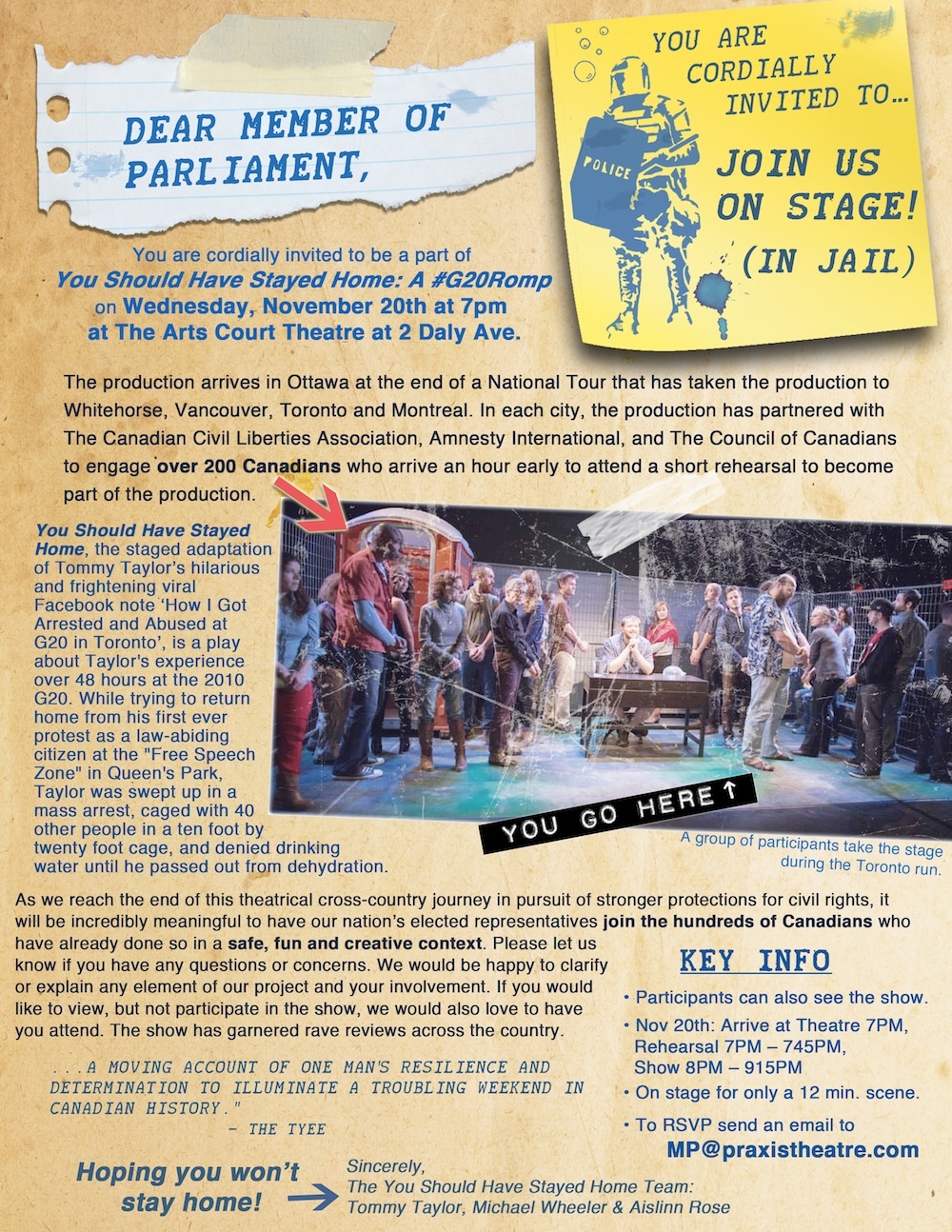
On Monday Dec 18 all 308 Members of Parliament will receive this invitation. CLICK TO ENLARGE
After 34 acclaimed performances of You Should Have Stayed Home in Whitehorse, Vancouver, Toronto and Montreal, we conclude our tour in Ottawa on November 20th. It is our hope some of our nation’s elected representatives will join us onstage on opening night.
The production will have a reception on Parliament Hill, the same day as this performance. We are extremely grateful to The Honourable Andrew Cash, Member of Parliament for Davenport, for organizing this event where MPs of all stripes can meet us and discuss the opportunity.
Reception for You Should Have Stayed Home on Parliament Hill
Hundreds of Canadians have already stood up for civil liberties in a safe and creative way by participating in a short scene in the middle of the show. Before each performance we’ve led a discussion about Canada’s Charter of Rights and Freedoms and how it’s been significantly weakened by G20 Toronto — a period Ontario Ombudsman Andre Marin called, “The most massive compromise of civil liberties in Canadian history.”
We hope Members of Parliament will be inspired by this level of engagement by ordinary citizens across Canada, and also stand up for civil liberties.
We have already confirmed participation by a few MPs, and we’re hoping for more. We’re encouraging MPs from all political parties to join us. Civil liberties are not a partisan issue. Everyone from libertarians, to socialists, to all of those in between, can find rare common ground on this subject. This important consensus can be communicated theatrically.
If you are an MP:
Please get in touch by email: MP@praxistheatre.com.
If you are not an MP, but live in Ottawa and would like to join us onstage:
Please get in touch by email: participate@praxistheatre.com.
If you are not an MP, but you would like to see your MP participate:
Please send them this post. If you tweet to them, be sure to use #G20Romp. Also, be sure to be nice.
Consider sharing this post on Facebook or whatever other social network you use.
Only through real momentum will we fully realize this goal. We are so darn close and we need your help.
A sincere congratulations goes out to playwright Nicolas Billon, who has just been announced as the winner of the Governor General’s Literary Award for Drama. Billon’s collection of plays FAULT LINES was published by Coach House Books earlier this year, and includes the award-winning plays Greenland and Iceland.
Rifles will premier in January, 2014 at the Next Stage Theatre Festival
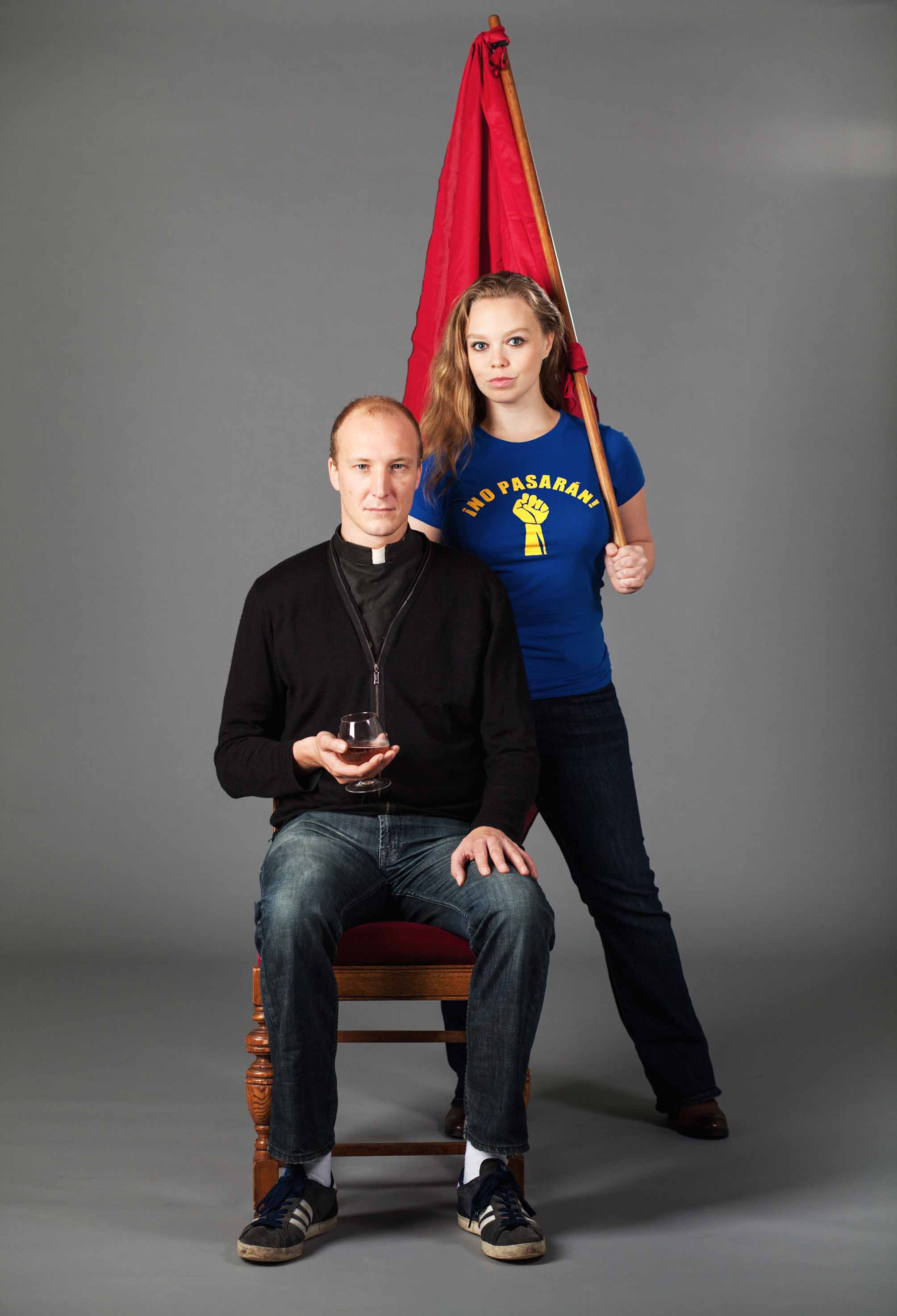
This announcement comes at a particularly exciting time for Praxis Theatre. We have recently begun a collaboration with Billon on a new work called Rifles. The play will be an original adaptation of Brecht’s Spanish Civil War ‘Call to Arms’ Senora Carrar’s Rifles, which Michael directed as a Shaw Festival Director’s Project last year.
We’re happy to be premiering this piece as part of Toronto Fringe’s Next Stage Theatre Festival this coming January. Having produced 6 Fringe shows over the last 10 years, we’re pleased to continue our association with such an important part of the Toronto theatre ecology.
Rifles will be presented as part of Next Stage on the Factory Theatre Mainstage from January 8th to 19th. Tickets go on sale soon.
Praxis continues its partnership with The Canadian Civil Liberties Association to use our play as an access point to contribute to the broader discourse surrounding civil liberties in Canada.
The CCLA has messaged members through email and social media encouraging participation in staging the play, and has partnered with us to create panel discussions on broader issues facing civil liberties in a number of the cities we are travelling to.
This Tuesday, following the 8pm performance of #G20Romp, we will continue the discussion about G20 Toronto with a discussion of many of the issues the play raises. Years after the largest mass arrest in Canadian history there are many unanswered questions, developments, and non-developments with regards to police actions at the Summit.
Abby Deshman – CCLA: Director, Public Safety Program
Abby graduated from University of Toronto faculty of law in 2008 and has an LLM from New York University law school. She has been a program director with the Canadian Civil Liberties Association for four years, and is currently the director of the public safety program. Her program area touches on all aspects of CCLA’s work on criminal justice, police powers, police accountability and privacy.
Leading up to the G20 she coordinated CCLA’s advocacy efforts on policing and protest, and during the meetings she led a team of independent observers monitoring police conduct. She interacts regularly with police forces across the country on issues of protest and policing and oversees the CCLA’s involvement in the struggle for post-G20 accountability.
On Tuesday, she will begin the day by heading up to OPP Police College to give a lecture to new Public Order Unit Commanders on protest rights.
Jan Borowy – Cavalluzzo
Jan Borowy’s practice areas include labour relations, human rights, pay equity and professional regulation. Jan brings to her practice a longstanding commitment to the promotion of workers’ rights and human rights. Her experience gives her an understanding of the importance of a clear strategy in union negotiations, campaigns, strikes, organizing and educational programs.
Jan is the former Research Co-ordinator at the International Ladies’ Garment Workers Union, where her work focused on a campaign for fair wages and working conditions for garment home-workers. She further developed her advocacy skills as the Worker’s Rights Community legal worker at Parkdale Community Legal Services. At law school, Jan developed an expertise in Aboriginal law and issues facing Aboriginal workers.
Jan’s experience within the firm has included close involvement in the representation of private sector and public sector workers before labour arbitrators, the Ontario Human Rights Tribunal, the Pay Equity Tribunal and the Ontario and Canadian Labour boards. Jan is a member of the Canadian Association of Labour Lawyers and the Canadian and Ontario Bar Associations.
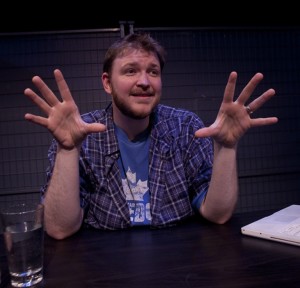
Tommy Taylor – Writer/Performer: You Should Have Stayed Home
Tommy is a theatre artist, activist and NGO fundraiser living in Toronto. Recently Tommy was assistant director/video designer on The Belle of Winnipeg (Dora Winner), adaptor/director of Dear Everybody at the CanStage Festival of Ideas and Creation and director of Kayak at The SummerWorks Festival. He is a graduate of the Centre for Cultural Management (University of Waterloo/ CCCO), The Vancouver Film School and Humber College’s Community Arts Development Program.
Tommy was arrested (but never charged) and detained during the 2010 G20 Summit in Toronto. He has since turned his account of the experience into You Should Have Stayed Home. The show is on a cross-Canada tour for Fall 2013, playing in Whitehorse, Vancouver, Toronto, Montreal and Ottawa.
SpiderWebShow is a theatrical space where Canada, the Internet and performance minds intersect.
It is Co-Created by Praxis Theatre Artistic Director @MichaelcWheeler and NAC English Theatre Associate Artistic Director @SarahgStanley, with Digital Dramaturgy and Design by praxistheatre.com creator @gfscott.
We have many goals with the show, but the first and most important one is to involve you.
Culture Vulture’ David C. Jones joined the show in Vancouver and talked to Tommy Taylor about the experience.
Hey Toronto,
Click to read J. Kelly Nestruck’s interview with Director Michael Wheeler
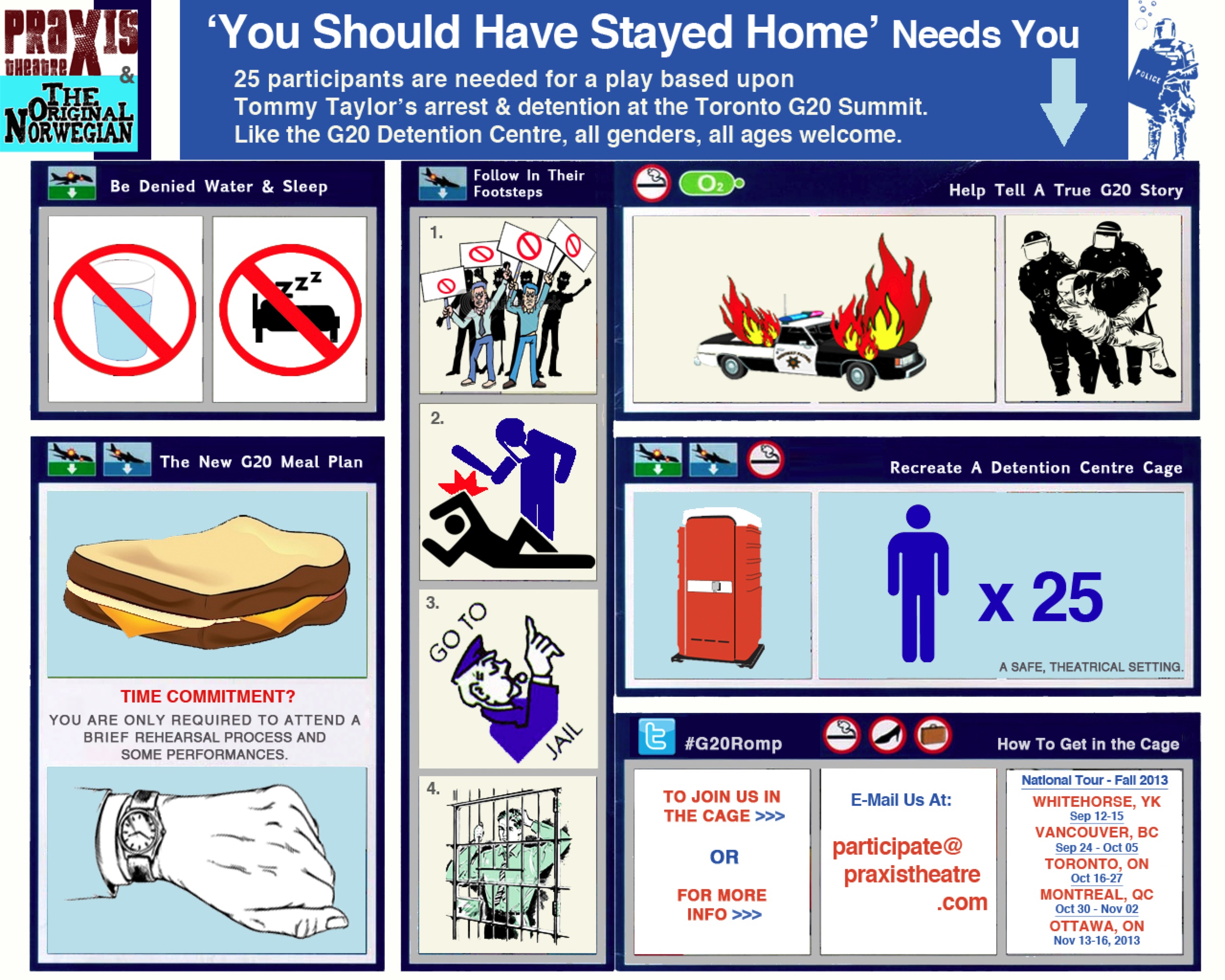
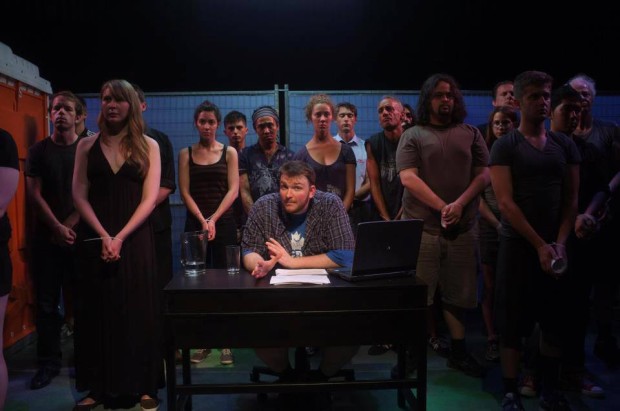
We want you to be in our play. Every performance of You Should Have Stayed Home requires a cast to join Tommy Taylor onstage for 12 minutes when the narrative arrives at The Eastern Avenue Detention Centre.
We have done this scene in many ways with over 150 participants total in Toronto (SummerWorks 2011), Whitehorse and Vancouver. The number of participants has varied from 15 – 40 over the course of these three runs. The scene always works, but emphasizes different elements depending on who and how many people participate on a given day.
We have had old cages, young young cages, mostly female, mostly male, sometimes packed, sometimes with enough room for each participant to sculpt their positions more precisely.
Each show happens with the people from the community it performs in who have chosen to participate on a given day. It is the social justice-influenced performative chaos theory that keeps our one-man show distinctly different and alive every night. We want you to join it.
How to participate in the show:
Click to read Glenn Sumi’s interview with Playwright/Performer Tommy Taylor
To join the production, send an email to participate@praxistheatre.com.
Let us know when you are available and would like to be part of the show. Do one show or do every show. People who do more than one show get a ticket to the show. People who do more than five get two tickets. The show runs from Oct 17-26.
Daily Rehearsals: Every time there is a show there is a ‘detainee’ rehearsal one hour before – 1pm for 2pm performances and 7pm for 8pm performances. At these rehearsals we’ll walk you through the 6 things you have to do – no acting experience required. Basically you have to be yourself if you had been swept up in a mass arrest: stand, sit, yell for water and play a volleyball type game. We have done this 25 times now. There is a safe, clear, fun system in place.
Want to see the show first? All detainee performers are welcome/encouraged to attend our dress rehearsal at The Aki Theatre on Wednesday October 16 from 7pm – 10pm. You can see the production and also learn what you have to do all in one 3-hour session.
Why participate? Every person who performs in the play is another voice that has stood up for basic Charter Rights that are in jeopardy in Canada. We think this matters, and hope you will too.
Click to read the review of You Should Have Stayed Home by Colin Thomas
and an ocean tumbled by with a private boat for Max
and he sailed off through night and day
and in and out of weeks
and almost over a year
to where the wild things are.
And when he came to the place where the wild things are
they roared their terrible roars and gnashed their terrible teeth
and rolled their terrible eyes and showed their terrible claws
till Max said “BE STILL!”
and tamed with the magic trick
of staring into all their yellow eyes without blinking once
and they were frightened and called him the most wild thing of all
and made him king of all wild things.
“And now,” cried Max, “let the wild rumpus start!”
“Now stop!” Max said and sent the wild things off to bed without their supper.
And Max the king of all wild things was lonely and wanted to be where someone loved him best of all.
~ Where The Wild Things Are, Maurice Sendak
Image:
Sound:
FeverGraph Theatre Company
Presents a variation of
John Osborne’s
Look Back in Anger
A physical and auditory deconstruction of John Osborne’s classic text
Continues this week – EXTENDED BY 1 DAY!
Wednesday, September 25th – Sunday, September 29th, 2013
Wednesday-Saturday at 8pm, Sunday at 2pm
1093 Queen St. West
Tickets: $20 regular $15 arts worker/student/senior plus applicable service charges
Ready to hit the studio and shit all on your mixtape
Nah, literally, shit all on your mixtape
Wipe with the credits, leave stains on the Jewel case
In just two takes, dog, the booth’ll get souffléd
You’re hiding something like a toupee
Truthfully, my friend: touché
You gon’ get exposed like an up-and-coming model
And to me your label seems like one of them pageant mommas
So guess who’s the little bitch? That’s you
You must suck a lotta dick: That’s true
Praxis Theatre is thrilled to announce their upcoming presentations of You Should Have Stayed Home, the staged adaptation of Tommy Taylor’s viral Facebook note, How I Got Arrested and Abused at G20 in Toronto. The show is a one-man piece of storytelling in the tradition of Spalding Gray, as Taylor recounts 48 hours in his life as a citizen on the streets and eventually caged in the detention centre.
DETAINEES NEEDED!
Part-way through the narrative, there is a scene that incorporates up to 25 participants that can be played by actors and non-actors when the action arrives at a cell in the Eastern Avenue Detention Centre.
In order to incorporate each community on every leg of the tour, Praxis is proud to be working with the support of the Canadian Civil Liberties Association, Council of Canadians and Amnesty International Canada’s Community Groups, Action Circles and Youth Activism branches, who are putting calls out for participants in each of the cities we visit.
Participants only need to attend one or two short rehearsals and as many performances as can be accommodated by their schedules.
You Should Have Stayed Home is a play about Tommy Taylor’s experience over 48 hours at the 2010 G20 in Toronto. While trying to return home from his first ever protest as a law-abiding citizen at the “Free Speech Zone” at Queen’s Park, Taylor was swept up in a mass arrest, caged with 40 other people in a ten foot by twenty foot cage and denied drinking water until he passed out from dehydration.
Taylor’s Facebook note, How I Got Arrested and Abused at G20 in Toronto went viral in 2010 and has since been translated into seven languages and appeared in twenty-one countries – a detailed, frightening and often funny account of the largest mass arrest in Canadian history. Tommy’s story has been covered by national and international media, including a Gemini-nominated CBC documentary named after the production.
After winning the largest cash award at the 2011 SummerWorks Festival, and becoming one of the festival’s highest grossing shows, Praxis Theatre is about to embark on its largest project ever: a cross-Canada tour to Whitehorse, Vancouver, Toronto, Montreal, and Ottawa.
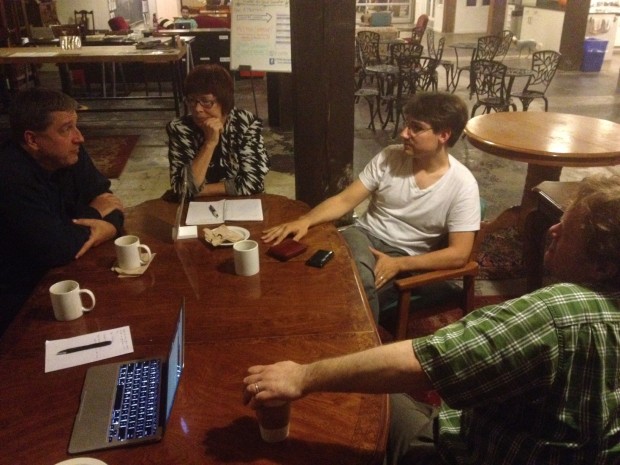
Ontario Councillors Mark Brownell, Vinetta Strombergs, Aaron Willis and Hume Baugh talking Equity with Praxis in 2012
ONTARIO EQUITY MEMBERS: You are cordially invited to attend this year’s C.A.E.A. Ontario Regional General Meeting!
Where: Factory Theatre, 125 Bathurst Street, Toronto, Ontario
When: Monday, September 9th at 7 p.m.
This year’s agenda is packed with many important issues that directly affect you as a member.
1: A preliminary status report from the Executive Director on CTA Engagement Levels 1 & 2
2: A new dues referendum on the horizon
3: Panel Discussion – The Incredible Shrinking Rehearsal Period
A timely examination of best practices in rehearsal. Why are we putting up with less and less rehearsal time in English Canada? How can the situation be improved? What can our association do about it?
Make sure you present your current membership card at the door. Drinks to follow. Join us!
“After the years and years of weaker and waterier imitations, we now find ourselves rejecting the very notion of a holy stage. It is not the fault of the holy that it has become a middle-class weapon to keep the children good.”
















Recent Comments