Category: acting
by Kristina Nicoll
For the last 6 weeks, I have not been working as an actress- but rather someone who casts actresses and actors- and I have had my eyes opened wide to the process of finding someone to “fit” a role.. and I want to write the following because I think it needs saying:
Stage actors and actresses are anomalies and jewels – if you have a resume which lists 10 or more theatrical credits in Canadian theatre- you are a national treasure, and you are in a field of a very few. This field is astonishingly smaller than you think. Much smaller.
I know this because I look at Casting Workbook everyday and I receive resumes and headshots… and add to that fact that if you are still active in the theatre after 20 years – YOU ARE A SUCCESS.
I can tell you that I am surprised constantly that resumes are organised with television and film credits first – as if they have more importance than what work you have done on the stage- who decided that?
I can tell you that if you do not celebrate your own accomplishments on the stage – then no one else will either.
I want to know how and why it was decided that holding stage credits up against hollywood credits was interpreted as success.
REALLY? DO YOU BELIEVE THAT?
I think that to be successful as an artist: is to despite all the odds; to keep on keepin on … and furthermore to be successful in this craft is to be the HEART of a human being , foibles, flaws, charms and vulnerabilities all – a believable human being in a vastly different set of circumstances/ genres/ stories.
THE END.
If you have a theatre resume, be proud, be so proud because despite all the odds and rejections and POVERTY… despite the pressure of the film/television world, YOU HAVE CONTINUED… and if you are a woman over 40, you have infinitely beat the odds-
Yes film is a visual medium and because its run mostly on the whims of adolescents in North America there is a pressure to look a certain way… but for real artists and grown ups- we are looking for your craft and for your soul and that is something YOU and your HEART and your experience of life brings.
So stop where you are and dont compare yourself or covet what you see as beyond you.
Luxuriate in what you have done, live your life as an extraordinarily lucky person, celebrate yourself, dare to change your resume to show theatre first.
The theatre is something to be proud of in this vast country because the professional theatre is arguably only 60 years old here. The blood, sweat and tears that have made it have come with blind faith and no money – The victories and the magic that happens – is yours, all yours.
Theatre was and will continue to be the reliable source of talent that goes into all the film and television that is made- not just here – but in many other countries in the world. I mean think about Broadway or the West End and how people use it to prove their legitimacy as “serious artists”. Please celebrate the theatre what you have given to its continuance. You are a gift, your craft is a gift, you have a “noble” calling , your numbers are few, and its time that you were celebrated. So I write this to celebrate you all.
You can all join my “agency” anytime, the door is open, the coffee and tea is always on, the table has food and a box of tissue, there are books for your souls and poetry for your heart, there are plays that will build beautiful new worlds, and there is a dram of something for courage when needed, and always a smile, a laugh and a story to remind you: you are loved and you are not alone, never alone.
I will fight for each and everyone of you to hold your heads high.. I raise my glass to you, I salute you and thank you for the courage of your hearts which has brought beauty, laughter, eye opening – consciousness raising challenges and pure love to mine..
Here’s to you: You agents of provocativeness and charm, you Socratic questions all…
xxx
Kristina Nicoll is Assistant Artistic Director of the Tarragon Theatre. She originally wrote this piece as a Facebook note to her friends.
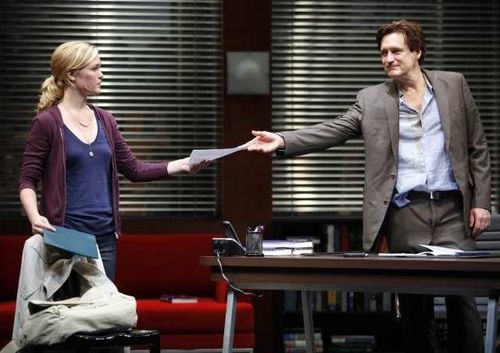
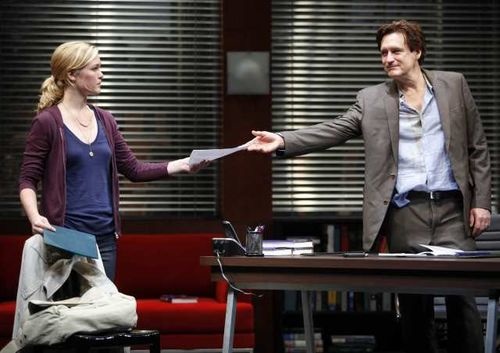
"As staged by Mr. Hughes, the current “Oleanna” flies bravely in the face of Mr. Mamet’s prescriptions about acting. “There is no character,” Mr. Mamet has written. “There are only lines upon the page.” This “Oleanna” squints to read between those lines, and Mr. Pullman and Ms. Stiles have obviously been encouraged to create characters who are more than what they say."
by Michael Wheeler
Although material on the Praxis Website usually refrains from mentioning or linking to reviews, famed New York Times theatre critic Ben Brantley’s review of the recent Oleanna revival in NYC is interesting enough to be come the exception that proves this rule.
In his review, Brantley makes the argument that the production starring Bill Pullman and Julia Stiles is not a success in large part because the performers do not use the correct acing technique: a Practical Aesthetics approach to performing the text developed by Mamet and taught by the Atlantic Theatre Company he helped to found.
The original production of Oleanna starring Rebecca Pidgeon (who is married to Mamet) and Practical Aesthetics co-creator William H Macy, “seemed to move at warp speed” and left Brantley, “with shortened breath and heightened blood pressure”. The current production he writes, “seemed slow to the point of stasis, and its ending found me almost drowsy.” Both productions had roughly the same running times.
Creating a complictaed and contradictory character is not normally a flaw in the approach of a performer. A medium still heavily influenced by Stanislavsky and Psychological Realism normally rewards those artists that create multi-layered characters who are “more than what they say”. In fact, not to do so in many post-Chekovian texts is to risk one-dimensionality – it is assumed that the process of creating a character includes plumbing the world between the lines to create the fully formed human being within.
Brantley argues that this is not however, the approach that should be taken with this text:, “because “Oleanna” is a play about people for whom language is a conditioned reflex: They don’t think before they speak, even when they believe they do.” This – in a nutshell – is the essence of the technique that Mamet and Macy have worked to develop. In direct response to what they refer to “the method”, Practical Aesthetics forces the actor rely on their will over their intellect by distilling the creation process to a three step process that prizes the text over all else.
Because I haven’t seen the production, it’s impossible for me to have an informed opinion about Brantley’s analysis. I broke one of the few rules of curating material for this site because I was struck by a review of a piece of theatre that was conscious of not only what elements the production succeeded and failed, but posited informed reasons why they did as they related to the craft and approach the artists used to create it. It seemed to me rare, insightful, and good evidence as to why having your show reviewed in The Times still matters a little more than all the rest.
Click the link to read the full review: He Said, She Said, but What Exactly Happened?

An English-speaking-ex-pat acting primer for Tokyo
By Benjamin Johnson
• In Tokyo, acting and modeling are basically considered the same thing.
• Anyone coming to town with some kind of work visa can get an agent, most foreigners have more than one agent, and I’ve heard of people signing up with over twenty different agencies, however Japanese citizens can only have one.
• Once you have an agent, you’ll get emails on your cell-phone with an exact amount the job pays and asking you if you’re available for auditions on certain dates.
• Once you confirm your availability they send your headshot in to the casting agent for “picture selection”.
• If you make it past picture selection you go to the audition, usually with a manager from the agency who acts as your translator and who also works out the details for you.
• Then if you get the job, you show up on the day.
Almost all work is acting in commercials. Although most Japanese can read advertisements in English, few can hold down a conversation, and most would be lost listening to English dialogue. The English-speaking actor in Tokyo is essentially a model paid to draw attention to products. Film and TV work is basically nonexistent, save for extra work and embarrassing guest appearances on variety shows.
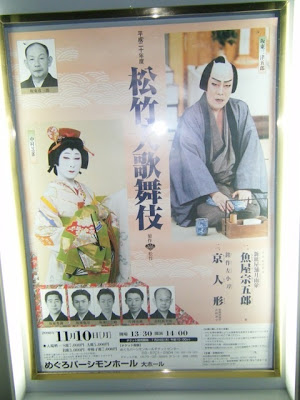
Theatre in Tokyo is similar to that in many other major cities. Japan has it’s own casts of Lion King, Cats and a host of musicals running endlessly. There are major houses doing translations of Ibsen and Shakespeare, traditional Japanese Kabuki and Noh plays, but as far as I can tell there’s not a single theatre job to be had for an English speaker in this town of 30 million people. The only agency that mentioned covering English speakers for theatre was a note on a list that said, “ask about theatre” next to the agency name.
There are of course, international touring companies, which perform in English, or without language, such as the new Cirque de Soleil show “Zed”. But for the most part, people are busy, life is expensive, and renting a space, rehearsing (i.e. not working a regular job), and producing a show is an expensive undertaking when your audience may not understand your carefully worded award-winning masterpiece that is basically all dialogue. Movement theatre would be the best way to go, and the Japanese already have the singular Butoh.
As for indie theatre in Tokyo, my next step is to visit a trendy neighborhood called
Shimokitazawa. I’ve heard there are some signs of a somewhat indie-theatre community. I’ll investigate and report back.
Benjamin Johnson is a screenwriter and graduate of Canada’s National Theatre School, currently living and working in Tokyo.
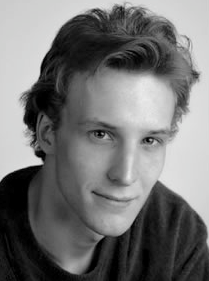 My First Headshot (1999).
By Michael Wheeler
A strange thing happened to me this year: I ended up splitting with my fancypants agent and doing more acting than I’d done in the four previous years with representation. It wasn’t something I’d planned. It just kinda developed, and it has me thinking all sorts of things about how and what I want to do in the theatre.
A year and a half ago I had seriously considered hanging up my acting shoes. Being Co-Artistic Director of an indie company and directing shows around town was fulfilling and taking up a huge amount of time. Running around to audition to be an SOC hockey fan in an insurance commercial, or talking broccoli (aka a principal role) in a Sobey’s spot seemed to be a distraction for the most part. I had been given some friendly advice from several quarters that “you can’t be all things to all people” and that if I really wanted to make a name for myself as a director, I should firmly establish myself exclusively as one.
This also made sense to me because acting wasn’t too much fun anymore. When I finished my acting MFA in The States I did the mandatory 1 year in NYC that your visa allows for. I turned into a serious stress case of an actor with essentially 10 months to become wildly successful in order to extend my stay. I started with a part in a show at The Ontological Theatre and spun that into a mediocre agent who also doubled as a radio commentator for the New York Giants. I hustled like crazy between open calls, what the agent could find me, and up to 5 different joe jobs, but much to my dismay I did not find myself wildly successful.
This was partially because the odds of this working out for me were pretty low, but also because of how I was performing and auditioning. The whole I must define my career with this performance attitude the situation had me left me too tense and probably in hindsight, desperate, to really do anything like that. I returned to Toronto just in time for SARS, signing on as the first male client of a failure of a startup agency before landing an agent who was decidedly blue-chip a year later.
The pitiful state of the industry and being the smallest name on a big time roster meant opportunities to audition for projects that weren’t advertising came on a bi-monthly basis. Six, five-minute opportunities a year, to establish myself. It wasn’t cool. I kept myself in classes, volunteered to read for casting directors, but nothing seemed to give. The experience contrasted heavily with the success we were having with Praxis and the whole being an actor for hire thing started to feel like a raw deal. Eventually the agent and I mutually agreed that we “were not a good match”.
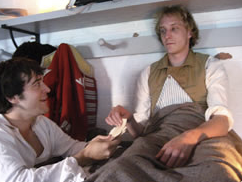 Fort at York workshop #1.
So I kind of surprised myself when I showed up to audition for The Fort At York. Over the course of two publicly presented workshops, I played first a mute kitchen boy named with a tendency to break into monologue, and eventually a soldier named Everett with some serious psychological problems in the final production. This led directly to playing an anarchist artist in Save Us at HATCH this year, I followed it immediately by acting in a Praxis Theatre show for the first time as The Prosecutor in our workshop presentation of Stranger.
And all of a sudden acting was a) fun again and b) I was much better at it. The major reason for this was simple: I no longer felt this overwhelming compulsion to make my career with a single performance. My breathing was controlled, shoulders went back, I found stillness, and had confidence in my ability to entertain without striving to entertain. All the little things I understood from my training intellectually, but hadn’t been able to incorporate practically with regularity. It’s tough to breathe from support and have crisp final consonants when you’re trying desperately to succeed like no one has ever succeeded before.
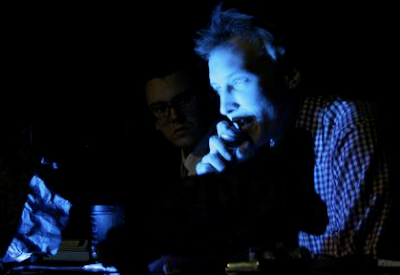 Save Us reading at Cameron House.
I am grateful to Tara Beagan, Chris Reynolds, Chad Dembski and Simon Rice for creating three shows that really fostered an exchange of ideas and valued collaboration in rehearsal. I had a lot of confidence in these projects because I was afforded the opportunity to play a part in things from the get-go. I also remembered something I forgot: I love opening night. As a kid I had hoped first to play for The Toronto Blue Jays and later, as a starter on any NBA team but The Utah Jazz. It was only after both of these goals proved entirely unrealistic that I started to get heavily into theatre at 16. In hindsight, I think I know why now:
Opening night as a performer, and all the shows that follow, is the closest you can get to approximating Game Day in sports. There is a specific time where you have to show up in front of a crowd of people. You get one chance to do something special with your teammates. The nerves, the excitement, the onus on yourself to thrive under pressure – once I lost an impossible sense of tension and just concentrated on the task at hand – it became addictive again. If I’m not going to play in the NBA Finals, this is as good as it’s going to get. And it’s pretty good.
So Mike the actor is back – resurrected from the graveyard of classic frustrations that plague actors in their first years out of a training program. Screw pigeonholing myself. Theatre pays so poorly we ought to do exactly the types of projects we would like to do and often you have to find these things yourself. And maybe a new agent.
This is the third in a series of four blog posts on theatre by Praxis Theatre Co-Artistic Director Michael Wheeler.




Recent Comments