by Michael Wheeler
Less than one month into his tenure in as the new ‘Arts Czar’, a position just created by Mayor Ford, Jeff Melanson has taken to the comments of the Torontoist website to launch a critique of their year-end post about Nuit Blanche:
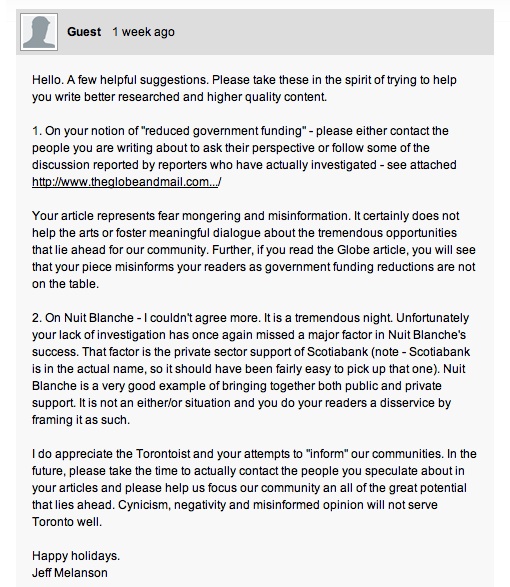
To summarize, the substance of Melanson’s comment comes down to three points that he makes related to the Torontoist post: 1) That arts funding will not be reduced under Rob Ford as Mayor; 2) Nuit Blanche is supported by Scotiabank and thus is especially not under threat as a corporate sponsored activity; 3) Any critical take on the arts in Toronto is misinformed and in fact anti-Toronto.
1) “government funding reductions are not on the table”
The only guarantee we have that Ford won’t cut the arts in a couple of years once he’s weakened key allies first is that Melanson will quit his non-paying, just-invented, part-time job if he tries. This isn’t a guarantee – it’s somewhere in between a red herring and an afterthought. I learned this was the deal, because I read the overwhelmingly positive, ‘Star is Born’ kind of interview with Melanson in The Globe and Mail that he provides as an example of laudable research and analysis. Just to clarify: articles that promote Melanson’s approach = good journalism; articles that critique it = bad journalism.
More significant is that Melanson already has a documented history of pulling a fast one on the Toronto arts community while technically appearing to increase arts funding: In early 2009, The Canada Prizes fiasco was caused by an incredible breakdown in the democratic process when the late David Pecault went over the head of Heritage Minister James Moore to convince Finance Minister Jim Flaherty to approve the only new cultural spending in the 09 federal budget to fund a $25 Million Nobel Prize of The Arts to be awarded annually in Toronto, a fact confirmed just last week by The Toronto Star’s Martin Knelman.
Eventually, it was revealed that the flimsy document used to propose the project had the names of a number of people and organizations that didn’t actually support it, and it was shelved due to this blatant misrepresentation of industry support and the backlash against what was generally agreed was a terrible idea across the country. Jeff Melanson is listed on this controversial document as one of the four key founders of The Canada Prizes, an initiative that would have massively increased “arts funding” in Toronto with 0% going to Toronto culture or artists, while cash, profile and prizes were awarded to artists from around the world. Two years later, scant details on this program have been announced by Canadian Heritage other than it will now be administered by The Canada Council.
Personally, I believe it’s quite probable “arts funding” as a broad topic will actually go up under Melanson. The real question is how and what will be funded. More eight-year-olds in tutus at The National Ballet, or across the city, are probably something Rob Ford can live with. Is now a good time to bring up the play about G20 I have been thinking about? Okay, maybe not. What if it was a commercial hit?
2) “Unfortunately your lack of investigation has once again missed a major factor in Nuit Blanche’s success. That factor is the private sector support of Scotiabank (note – Scotiabank is in the actual name, so it should have been fairly easy to pick up that one). Nuit Blanche is a very good example of bringing together both public and private support.”
The crazy thing about this one is that it is written right in the Torontoist article: “Since Nuit Blanche is already mostly a privately funded event—thanks, Scotiabank—it’ll probably continue regardless of Ford’s slash-and-burn efforts” prompting one commenter to write, “Did you even read the post Jeff?” What this tells us more than anything is that Melanson probably didn’t read the post more than once before deciding to respond in a huff. If he did, he would have realized that he spent half of his time refuting a point that was never made. It also makes his parenthetical ‘dig’ at the author’s “lack of investigation”, possibly worthy of an apology. Do Arts Czars have to apologize when they’re wrong?
Again, there is a more troubling layer to this response, namely that Melanson thinks “Scotiabank Nuit Blanche” is the “actual” name of the event. Perhaps he is unaware that Nuit Blanche is a concept that occurs all over the world, most notably in Paris. In these cities the “actual” name of the event is “Nuit Blanche”. Toronto is the only major world city to sell a corporation naming rights to a Nuit Blanche.
This could be what Melanson would view as being “entrepreneurial”: selling the right to change the “actual” names of public events to corporations. It is an interesting debate, but certainly not one where there is a lot of consensus, with at least one prominent city hall activist calling for Torontonians to refer to the event as BMO Nuit Blanche in any of their social media communication about the event.
3) “I do appreciate the Torontoist and your attempts to “inform” our communities. … Cynicism, negativity and misinformed opinion will not serve Toronto well”
I’m confused why it’s not obvious when you use quotes around words like “inform”, people know that you don’t really mean it. It’s like showing that your fingers are crossed while fibbing.
As for the demand for a positive response – if one thing’s for sure when you’re Rob Ford’s Arts Czar – it’s that Haters Gonna Hate. Even if after this inauspicious start, he does an incredible job, there will still be someone in the blogosphere with an axe to grind. This is a position that is going to require thicker skin. People say untrue things on the internet all the time – how do you think Rob Ford ended up Mayor?
Since this disastrous posting, Melanson has arranged a second, ‘Star is Born’ interview, this time with The Toronto Star’s Richard Ouzounian that fails to address the Torontoist posting or The Canada Prizes, but does make him seem like the next Justin Bieber. This was presumably to do some damage control on the whole situation, and also add a little clarity regarding his priorities and mandate.
Melanson has some good ideas, especially about homegrown hits and the importance of increased diversity. Clearly his arts education ideas borrow heavily from the gospel Simon Brault has been spreading. Brault has been pushing a national Participaction type program for the arts, which makes sense since Brault is CEO of National Theatre School and Melanson runs the business side of the National Ballet School.
Most disappointingly, he refers confusingly to Toronto Alliance for the Performing Arts (TAPA) as “an advocacy organization”. This is a statement from someone as experienced as Mr. Melanson, that can only be characterized as deliberately obtuse – certainly someone in his position knows the difference between an “arts service organization” and an “advocacy organization”. TAPA is an “arts service organization” that provides a variety of services to performing arts organizations across the city. Occasionally it advocates on behalf of its members – as well as running workshops. TO Tix, The Doras and a number of other community-based programs.
A good example of an “advocacy organization” would be The Arts Summit, which has been successfully advocating for fourteen years for increased government funding of institutions with operating budgets of $5 million or more (like the National Ballet) while keeping the door shut to smaller organizations and independent artists. If I’m wrong here, prove me wrong: get independent artists and mid-sized organizations from across the country a place at the table when The Arts Summit comes to Toronto from April 1-3 2011. As long as these major institutions dominate cultural policy through formal and informal networks, whether or not “arts funding” goes up or down is just window dressing to the real decisions being made behind closed doors.
by Michael Wheeler
Last winter the Canadian cultural community was shocked to learn the only new cultural funding of the big “2009 stimulus budget” would be an international $25 million Nobel Prize of The Arts/ competitive arts festival with qualifying rounds where the grand winner in each category would perform at Luminato. Soon after, it was revealed that falsified documentation about who’d been consulted was used to pitch the prize to the government. (Exactly how did that process work?) At the same time voices in Quebec were becoming increasingly uncomfortable about the Toronto-centric Anglo bias to the project, and many other voices nationally in the cultural sector began speaking out against cutting domestic funding in tandem with creating a large international award. Soon after, the initiative was classified as “under review” and no one ever heard about it again.
Well guess what? It’s back.
Minister James Moore announced yesterday that The Canada Prizes will happen, are no longer connected to Luminato, and will be administered by The Canada Council. There is a five-member Advisory Panel that will do some super-fast, but extensive consultations with “key figures in the arts and culture sector” before advising the Minister on the best way to set the thing up by the end of the summer. For anyone unlucky enough to be considered “not-key”, you can contribute your thoughts through an online form available for just 17 days at this link on the Canadian Heritage Website.
It’s hard to have a single opinion about all this: In some ways putting this cash in the hands of The Canada Council is the best, smartest, depoliticized way to distribute arts funding. So fundamentally I’m not sure that the specifics of the award will be all that controversial as long as it is distributed by an arms-length jury. The crazy part about this whole process, and the media coverage of it so far, is the lack of attention to whether the prize is a good idea to begin with.
The stated goal in the Ministry’s press release is to “brand Canada as a centre of excellence”. Which is a good idea – except for one thing – after we’re branded as excellent, we will have to create things that are excellent. Things aren’t looking so hot on that end – between the policies of current Federal and Provincial governments and the economic crisis – actual monies for art going to artists is way down. Farewell DFAIT, Trade Routes, PromArt, small magazines, endowments, and BC artists. Bonjour a huge amount of money to an artist at the top of his or her career and the administrative and production costs of a massive international ceremony.
So more than anything this just seems like putting the cart before the horse. We would like to be branded as excellent, we would like to be perceived as excellent, but we are going to reduce the funds that would lead to excellence. (We will however throw you a big party if you ever get there.) It is a common approach to Canadian cultural funding these days that is a lot like encrusting the tip of a melting iceberg with gold. It should also probably be noted that it creates an inverse relationship between the creation of art and “fancy galas“.
Since the majority-that-almost-was in 2008, the Conservative government has been looking for ways to appear pro-culture while not actually funding any of the art or artists that contributed to their unrealized ambitions. This prize fits firmly in this category of things that will allow the government to say that arts funding is “up” while continuing to decrease the amount that is actually allocated to culture, either directly through grants to artists or indirectly by subsidizing rehearsal, performance space, equipment, travel costs, etc.

Ironically, when the Minister of Official Languages and Canadian Heritage re-announced the prize yesterday, he received extensive coverage in the media – for something seemingly unrelated: In a hockey-induced fit of pride over the weekend he’d twittered the Vancouver Canucks were “Canada’s team in the playoffs”, seemingly unaware that many Canadians consider Quebec a part of Canada. (And all of a sudden we got a glimpse of how they could just forget to put French in the opening ceremonies of a Canadian Olympic games.) In an article in today’s The Globe and Mail he remains unrepentant and stands by his tweet and seems unabashed by the notion that Tweets Have Consequences.
So here we are right back where we started eighteen months ago, except everyone’s a little more hurt and a little more bitter: Anglophone artists are increasingly starved for support, francophone artists are armed with multiple instances of the government trying to exclude Quebec from the definition of Canadian culture, and a hostile government is inventing new and interesting ways not to fund the ecosystem that creates Canadian culture in both official languages. I am going to be so relieved to talk about this era in the past-tense.
If you want to read THE OLD Canada Prizes outline – the one that no one wants to talk about anymore – click here. It seems only fair that interested citizens wishing to provide feedback to the government have (unredacted) access to the documents used to create and approve the initiative.

Back-to-back articles have appeared in Toronto’s two most-read newspapers, The Toronto Star and The Globe and Mail, regarding creativity and artists that seem to underscore a dissonance between government spending and economic objectives.
The first piece in The Star titled “
Report urges ‘creativity-oriented economy’ for Ontario”, summarizes a multi-million dollar report prepared for the provincial government on how to prepare our economy for the future. Amongst the recommendations:
“- Set a goal of having more than 50 per cent of Ontario’s employment in “creativity-oriented jobs” by 2030. Currently, 30 per cent of jobs are in that category, accounting for nearly half of all wages.”
The second piece in The Globe titled, “Starving artists? That’s not far from the mark”, analyzes a report based on the 2006 census commissioned by The Canada Council for the Arts, The Ontario Arts Council, and The Department of Heritage. Amongst the conclusions:
“What makes the situation even more distressing is that artist earnings have been decreasing since 1990 – a decline likely to intensify over the next two years. While average earnings for the overall labour force rose by almost 10 per cent from 1990 to 2005, artists experienced a slide of 11 per cent – to $22,731 from $25,433 – at the same time as the cultural-sector work force tripled in size. Actors experienced the sharpest decline in average earnings among artists, dropping 34 per cent to about $18,000 in 2005.”
Both of these studies come on the heels of the Department of Heritage announcing a new strategy to spend $25 Million to create The Canada Prizes, an American Idol-style competition that uses big money cash prizes to attract non-Canadian talent for a one week in June in Toronto.
These two studies seem to contrast greatly with the latest funding announcements made by brand new Heritage Minister James Moore. Will the trickle down economics of this one-week bonanza reap dividends for taxpayers seeking to revitalize a domestic creative economy? What role do artists play in a society seeking to increase creativity-oriented jobs by 20%? If your country’s artists are living in poverty and the situation is getting worse, can you expect to make this economic shift?

This week’s federal budget contained few surprises, but there was one item that came out of left field, shocking the cultural sector: Luminato founders David Pecaut and Tony Gagliano, pictured above, have been granted $25 Million to create the Canada Prizes for the Arts and Creativity.
A number of artists have expressed ire that this announcement comes on the heels of the cancelation of the PromArt program, abandoning the federal government’s commitment to promoting Canadian artists abroad. This new money will be used to host a pre-Luminato competition, where prestigious panels of judges will adjudicate international competitors in the fields of dance, music, art, and dramatic arts. The winner gets cash and a slot in the two-year-old festival that recently received another unprecedented $15 Million donation from the Ontario provincial government. New Conservative Minister of Heritage James Moore calls The Canada Prizes “the largest cultural prize-giving in the world“.
What do you think? Is this a genius ploy to make Toronto an international hub for arts and creativity? Is this a genius ploy to to fund culture without rewarding Canadian artists for depriving the Conservative government of a majority in the recent election? How the heck do these two dudes get multi-million dollar grants from any level of government that no one else can apply for?





Recent Comments