The issues explored in David Mamet’s controversial play on political correctness, education, and power politics, Oleanna, stand up to the test of time.
They have as much resonance today as they did when it opened to audiences in 1992.
The only problem is, while showcasing some of Mamet’s best writing, the play is ultimately mired by his inability to transcend his own personal prejudices.
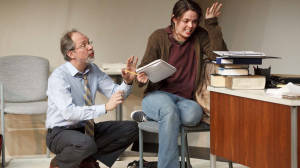
Diego Matamoros & Sarah Wilson in Soulpepper's remount of Oleanna
Almost twelve years after directing the show myself, I went to see Soulpepper’s remount currently playing at The Young Centre. This isn’t a review, so I won’t be commenting on the production.
What stood out to me this time around, was just how flawed a play Oleanna is.
This comes partially from a great disappointment at how well the play begins, and how badly it finishes.
The first act has the promise of brilliance. Carol, a confused and somewhat neurotic college student, appears in the office of John, her professor, looking desperately for answers.
She is failing, and she can’t understand why. John has little time for her at first, more interested in answering a phone that rings incessantly and preoccupied with the impending purchase of his dream house.
John is the archetypal verbose intellectual, who challenges all excepted norms in his academic life, while happily accepting the spoils, both power and money, the profession rains upon him.
John is a wholly actualized character. Carol is not.
John’s great strengths and weaknesses are laid bare.
He is arrogant and snobby, and yet he makes the important decision to try and reach Carol in a less than orthodox way
If we’re going to take off the Artificial Stricture, of “Teacher,” and “Student,” why should my own problems be any more a mystery than your own?
He then goes on to talk about his predictable, upper-middle class dilemmas in a typically arrogant and paternal way.
Nice house, close to the private school… (He continues making his note.) … We were talking of economic betterment (CAROL writes in her notebook.) … I was thinking of the School Tax. (He continues writing.) (To himself:) … where is it written that I have to send my child to public school. … Is it a law that I have to improve the City Schools at the expense of my own interest? And, is this not simply The White Man’s Burden? Good. And (Looks up to CAROL) … does this interest you?
But despite his great flaws, he opens up a compelling discussion on the value of post-secondary education.
We shove this book at you, we say read it. Now, you say you’ve read it? I think that you’re lying. I’ll grill you, and when I find you’ve lied, you’ll be disgraced, and your life will be ruined. It’s a sick game. Why do we do it? Does it educate? In no sense. Well, then, what is higher education? It is something-other-than-useful.
When Carol challenges John on how he can disparage education, to those who have in many cases, “over-come great obstacles to get here,” he replies that it is his job to challenge and provoke thought in his students. Carol seems unable to grasp this idea.
So whether you like him or his ideas, John is a real character, at least somewhat worthy of our empathy.
Carol is less a character than a straw woman. Mamet uses her, simply as a vehicle, to drive Oleanna towards a conclusion that confirms his suspicions: that political correctness is used by feminists, in a witch hunt, that has as its ultimate purpose the removal of humanity from human interaction.
Whether you believe this or not doesn’t matter, because Mamet makes his case so poorly.
In the first act Carol is written, rather one-dimensionally, as seemingly inarticulate, desperate, angry, and completely lacking self-esteem.
Nobody tells me anything. And I sit there … in the corner. In the back. And everybody’s talking about “this” all the time. And “concepts,” and “precepts” and, and, and, and, and, WHAT IN THE WORLD ARE YOU TALKING ABOUT? And I read your book. And they said, “Fine, go in that class.” Because you talked about responsibility to the young. I DON’T KNOW WHAT IT MEANS AND I’M FAILING…
Simon Rice and Sara Wood also staged their own Oleanna in the pre-Praxis days with Bloody Theatre in 1998
Mamet reveals nothing of where she is coming from or what her background is. If she has a life outside of being a failing student, we’re not privy to it.
Remarkably when Carol returns in the second and third act, this time on decidedly less friendly terms, she has developed great self-confidence and a sophisticated vocabulary.
… It is a sexist remark, and to overlook it is to countenance continuation of that method of thought. It’s a remark…
… What gives you the right. Yes. To speak to a woman in your private… Yes. Yes. I’m sorry. I’m sorry. You feel yourself empowered … you say so yourself. To strut. To posture. To “perform.” To “Call me in here…” Eh? You say that higher education is a joke. And treat it as such, you treat it as such. And confess to a taste to play the Patriarch in your class. To grant this. To deny that. To embrace your students.
Of course we still have no idea why Carol is doing this, or where she is coming from, only that she is single mindedly bent on John’s destruction.
I don’t care what you feel. Do you see? DO YOU SEE? You can’t do that anymore. You. Do. Not. Have. The. Power. Did you misuse it? Someone did. Are you part of that group? Yes. Yes. You Are. You’ve done these things. And to say, and to say, “Oh. Let me help you with your problem…
This is the problem with Oleanna. The questions it asks and tries to address are fascinating, and without easy answers. But Mamet tries to give us easy answers in his conclusion.
He wants us to feel that John is righteous and that Carol is a monster, and he succeeds.
In his 1999 provocation, True and False: Common Sense and Heresy for the Actor, David Mamet asserts, “most teachers of acting are frauds, and their schools offer nothing other than the right to consider oneself part of the theatre… Formal education for the player is not only useless, but hurtful,” says Mamet. “It stresses the academic model and denies the primacy of the interchange with the audience.”
Let me be clear, while I believe Mamet’s edicts to be wonderful conversation starters they are limited in their worth, not to mention hypocritical—he is himself an acting teacher.
Theatre schools are indeed strange places, seemingly full of contradiction. They are almost impossible to describe to someone who hasn’t attended one. At my earliest (and unsuccessful) audition for a prominent Toronto theatre school, I and the other nervous applicants were treated to a half hour lecture on why we shouldn’t go to school for acting. Perhaps this was an attempt to weed out those who didn’t have the conviction or depth of character required to survive three years of physical and emotional turmoil.
Theatre schools, not unlike some other training programs for highly competitive fields, seem to have adopted the baptism by fire approach. If you can survive it, you can survive anything, with the exception, perhaps, of a career in acting.
When I was finally, after several attempts, accepted into a three-year program, it was explained to my class that our “journey” would be structured more or less in three parts.
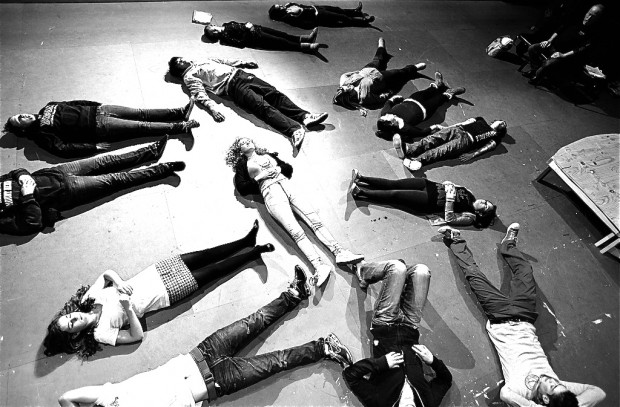
First year we would be pulled apart, literally and figuratively. All of our preconceptions about the craft would be exposed to the light of day, all of our “blocks” opened, both physically and mentally. Much of this, “opening” would occur while lying prostrate on a studio floor. We would, we were warned, find this process both painful and confusing.
During second year we would slowly and carefully be pulled from the floor and put back together, so that we could hit the stage on our feet in final year, which would consist primarily of full scale productions.
I suppose, beyond sounding slightly cultish, if it worked it would all be worth in the end.
Six years after graduating I look back at my theatre school experience with a mixture of emotion, which ranges from sweet nostalgia to blinding rage. But when I take a deep breath and the feeling passes I start to wonder.
Do theatre schools in all their various contemporary forms serve young aspiring actors well?
My guess is that the answer to that question depends on individual experience. What school, what teachers, what students etc. And there is no doubt, that from school to school, while there are often great similarities, there are also vast differences in styles, methods, approaches and philosophies.
And so it is in the spirit of genuine open-minded investigation that I will begin a series of conversations here on the Praxis website, called Exit Interviews. I will talk to former theatre school attendees, graduates, non-graduates, as well as former students who are now teachers, from a variety of schools across Canada and North America. My hope is to broaden our understanding of the contemporary theatre school, its strengths and weaknesses, through the honest reflection of those who survived it. Stay tuned!
If you attended theatre school and would like to weigh in on this conversation, please leave us your comments below or send us an email to info@praxistheatre.com. I look forward to the debate!
CIUT’s Catherine Kustanczy sat down with Praxis Theatre Co-Artistic Director Simon Rice last week to discuss the company’s current production of Stranger at The Theatre Centre in Toronto. Here’s the interview.
By the way, this weekend is your last chance to catch the show.
We’re also offering a special blog-reader discount for our closing weekend. Here’s how it works: If you’re buying your tickets at the door, say the words, “Theatre is territory” at the box office and we’ll reduce the price of your ticket by $5 . . . down to a cool $15. Sweet!
Praxis Theatre is thrilled to announce that after more than two years in development, our brand new show is almost ready to go.
The show is called Stranger and it’s based on Albert Camus’ 1942 existential masterpiece novel L’Étranger.
To help you get a sense of the show, we’ve put together a brand new website with production information, photos of the cast, free downloadable wallpaper for your desktop – you can even buy tickets right from the site.
We’ll be updating the site regularly leading up to the show’s opening on January 23 and throughout the run. Please stay tuned for more details as we get closer to opening night.
Good news Praxis Theatre Co-Artistic Director Simon Rice has resurrected his widely beloved U.S. politics journal The Rice Report.
A Rice Report primer The Rice Report started back in 2004 – a reaction to Simon’s growing distress with the state of American politics and its questionable foreign policies. His Rice Report newsletter series used the 2004 U.S. presidential election as a springboard to foster rigorous (and informed) discussion of an increasingly compromised democratic process.
His weekly reports became wildly popular among a small group of followers – and included a live play-by-play “performance” of the controversial Kerry-Bush showdown on election night: Tuesday, November 11, 2004.
A new blog We are thrilled to welcome Mr. Rice to the blogosphere and announce the return of The Rice Report. Among the topics he’s promising will be in the cards:
Who’s running? From Hilary to Huckabee, the A-Z on 2008! 2004 Aftermath– Was the general election stolen? The Hidden History of 9/11– A weekly crash course for beginners and/or skeptics.
And if you’re wondering what any of this has to do with theatre, check Simon’s response to one of our 10 questions:
6) How has your interest in American politics influenced your ideas about theatre? American politics have all the great elements of drama – farce, tragedy, absurdity, heroes, villains, clowns – the stakes are always high and although much focus has been put on the circus-like atmosphere of modern American politics, we all want to know what the next Act will bring. The Bush administration has felt like the usurping power in one of Shakespeare’s histories. With Donald “Rummy” Rumsfeld emerging as chief rhetorician, uttering such poetic lines as, “The absence of evidence, is not evidence of absence,” when no WMDs were found in Iraq. That’s a beautiful line!
I guess what I’m saying is that my passion for American politics deepens my understanding of theatre, and vice-versa.
Click here to get to The Rice Report, then hit “Bookmark” on your browser. You’ll be glad you did.
“After the years and years of weaker and waterier imitations, we now find ourselves rejecting the very notion of a holy stage. It is not the fault of the holy that it has become a middle-class weapon to keep the children good.”





Recent Comments