Subject: Byron Laviolette
Date: Friday, March 16th, 2012
I met Byron several years ago, at the Fringe when he was with a Morro and Jasp show. This is the record of a day we spent together, to better understand the life of a man who runs with clowns.
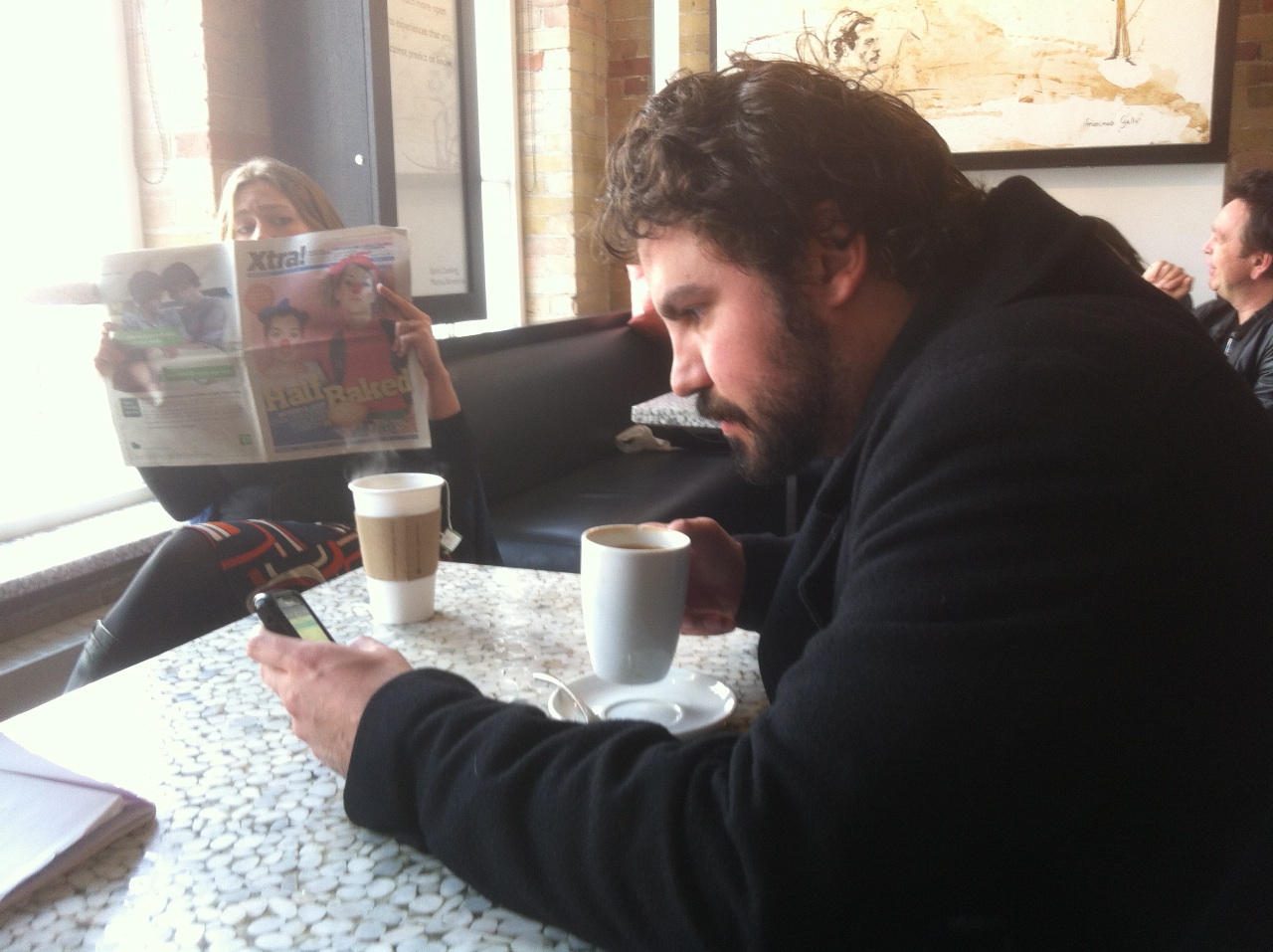
Noon: The subject suggests we meet at B Espresso, a trendy coffee shop on East Queen at noon. At ten minutes past noon, the subject appears wearing a rumpled overcoat, a white tshirt, and a hangover. I think maybe this is a “sad clown” look.
Inside the subject orders a coffee: a double Americano with “cream for colour, sugar for taste, and cinnamon for ‘shapam’” I don’t know what that last word means. Maybe it is Clown for “delicious”.
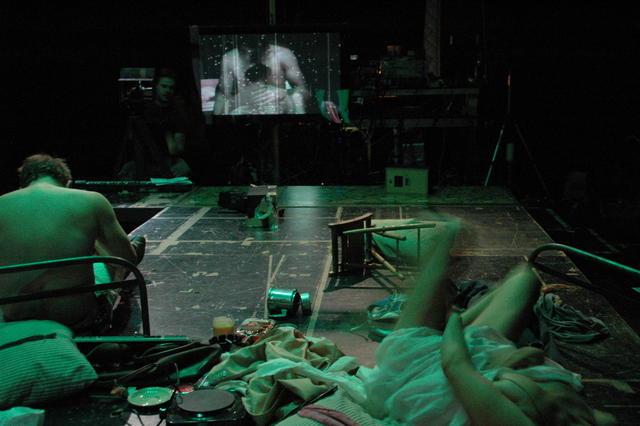
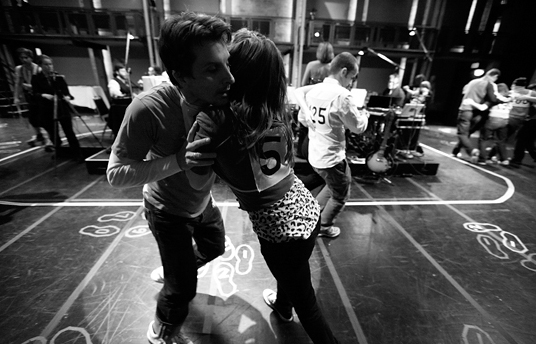
12:30 pm: The subject has brought me to what appears to be a terrorist cell meeting. Or maybe it’s for a show. It’s hard to tell. If they are terrorists, they’re really nice about it, which I suppose is what I should expect of Canadian terrorists. None of them appear to be clowns.
Also what my Existentialism notes looked like
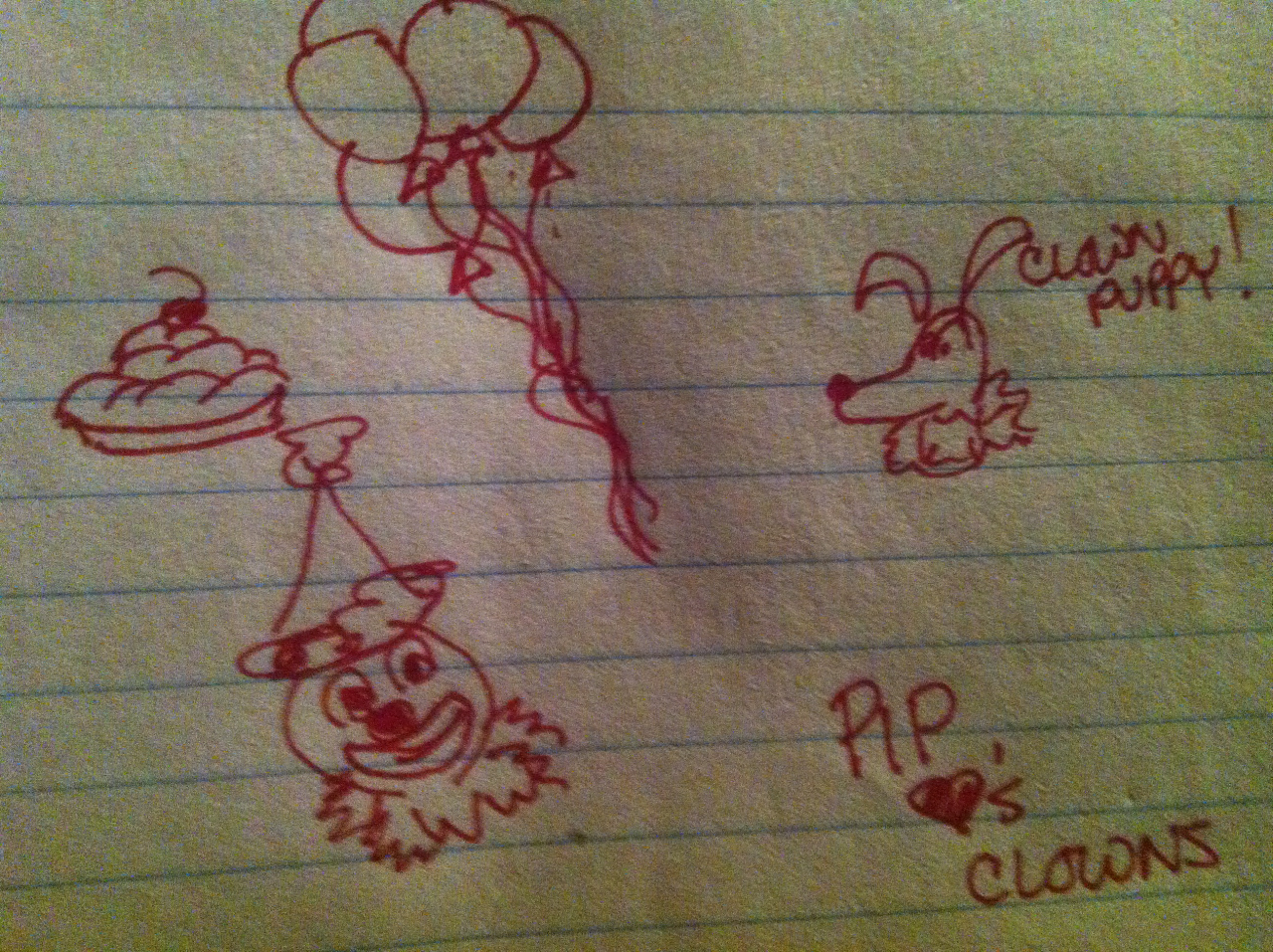
12:55 pm: The subject makes sure to keep me in the loop during the meeting. Meanwhile, I doodle pictures in my notebook of cream pies and red noses, and pretend I’m making notes.
1:00 pm: It is, in fact, a meeting about a show called ZED.TO. It’s a really neat immersive, experiential concept piece, but there are no clowns in it.
1:15 pm: The meeting adjourns. We smoke a cigarette.
1:30 pm: Social media break. I upload a picture of a lemur to my Facebook page.
1:40 pm: We get on the subway to go to Woodbine. On the way, we gossip about people we don’t like. Then we talk about shows we loved. Then we talk about my new job.
We do talk briefly about clowns.
Seriously, where are we?
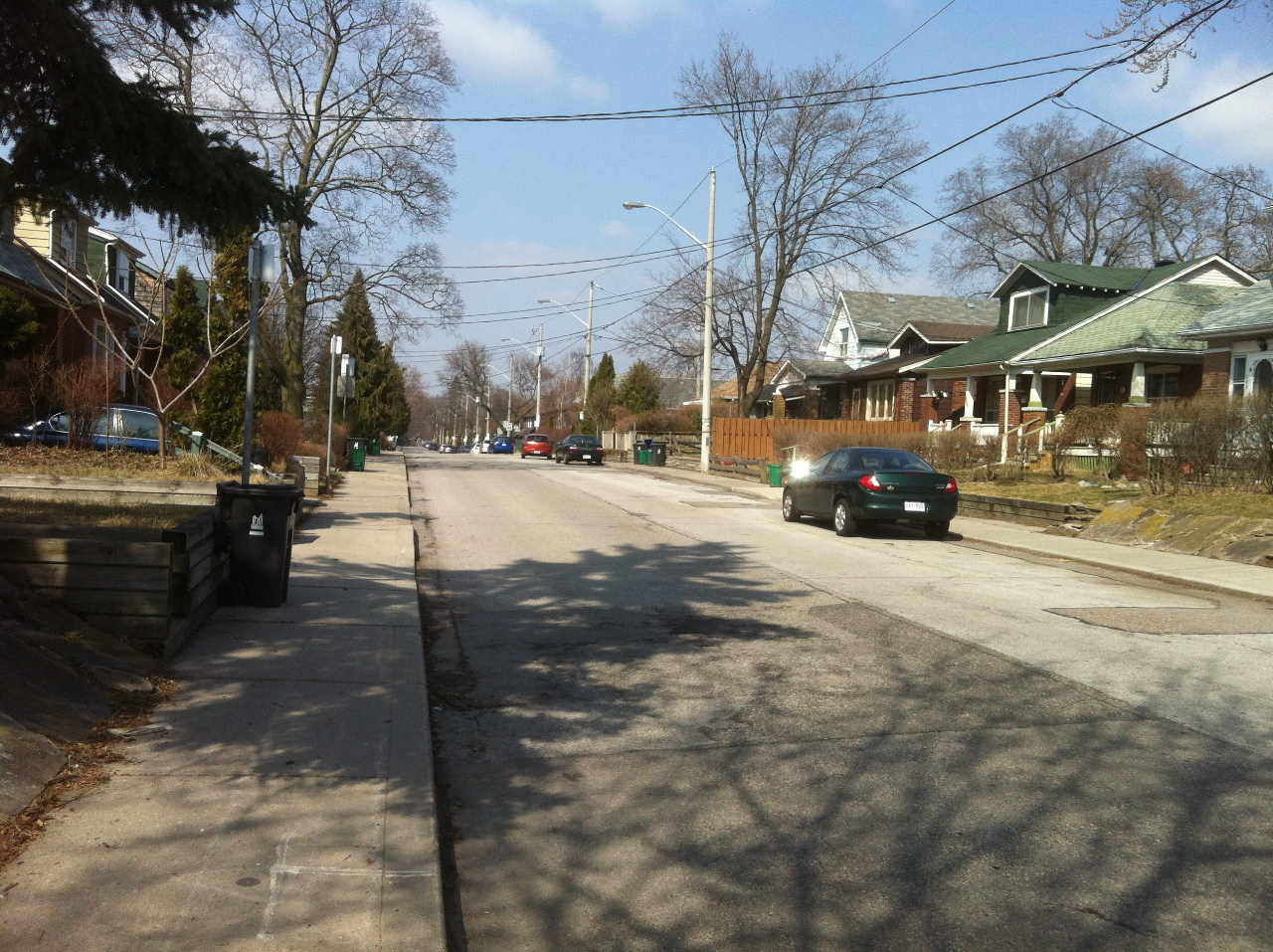
2:05 pm: We arrive at our destination. Upon emerging from the subway station, it appears we have gone into the Heart of Darkness: the extreme East End of Toronto. We smoke a cigarette and check our smartphones.
2:30 pm: We arrive at the house of one of the subject’s associates, Amy Lee, a known clown, to examine a red carpet with sun damage. The subject needs it for a benefit event on the following Tuesday, and he’s hoping to call upon my dubious expertise. Eventually we decide to simply cut off the yellowed bits. We smoke a cigarette and agree to go get another coffee.
3:15 pm: We get lunch at a café on the Danforth. Nothing humourous happens.
Not clowning around
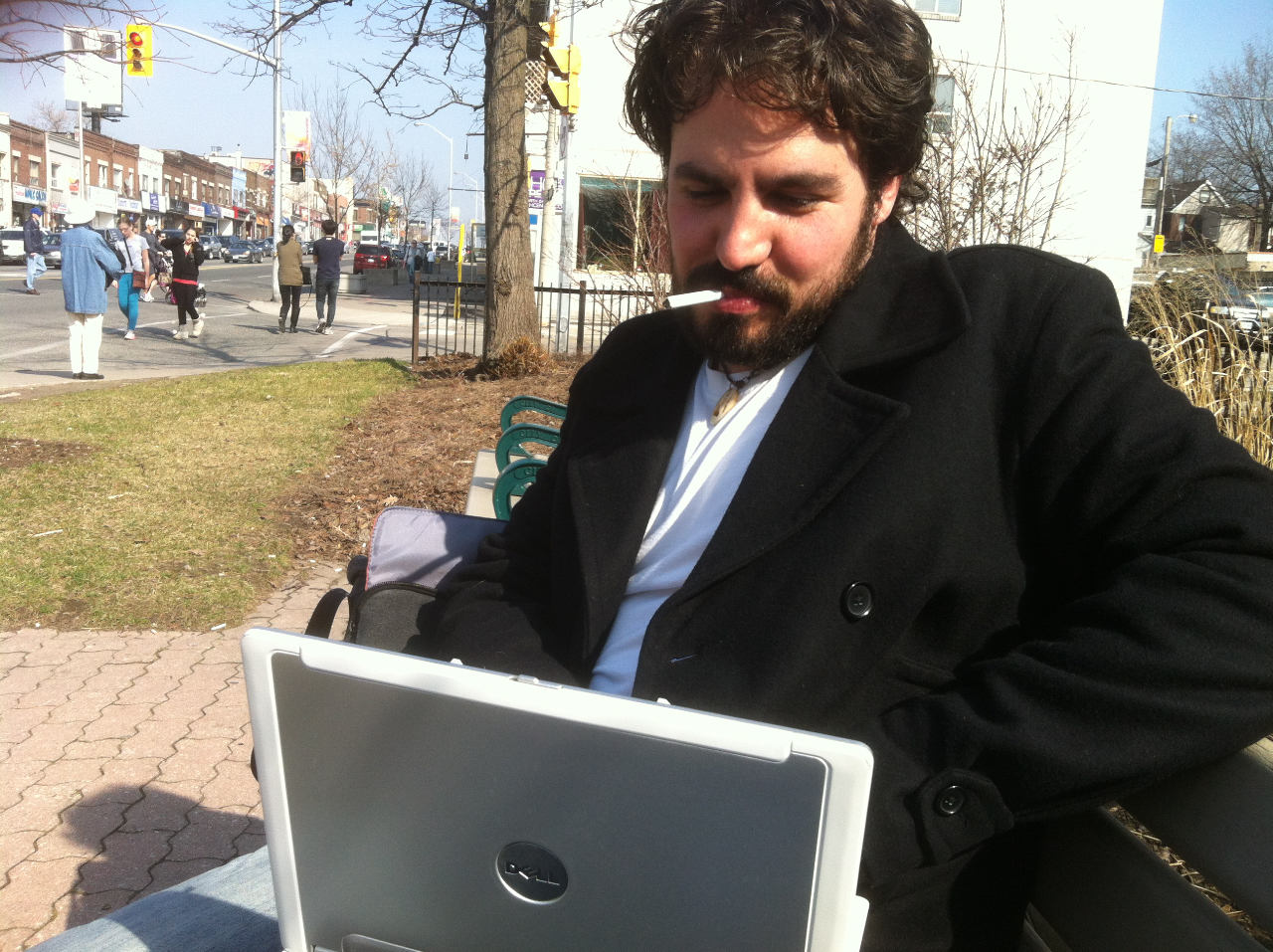
4:00: The subject tells me that this part of the day is normally his office hours. This appears to consist of finding an empty park bench and fooling around on his laptop. After I take a few photos with my iPhone, we decide to go visit one of his associates in the neighbourhood.
The home of a known clown
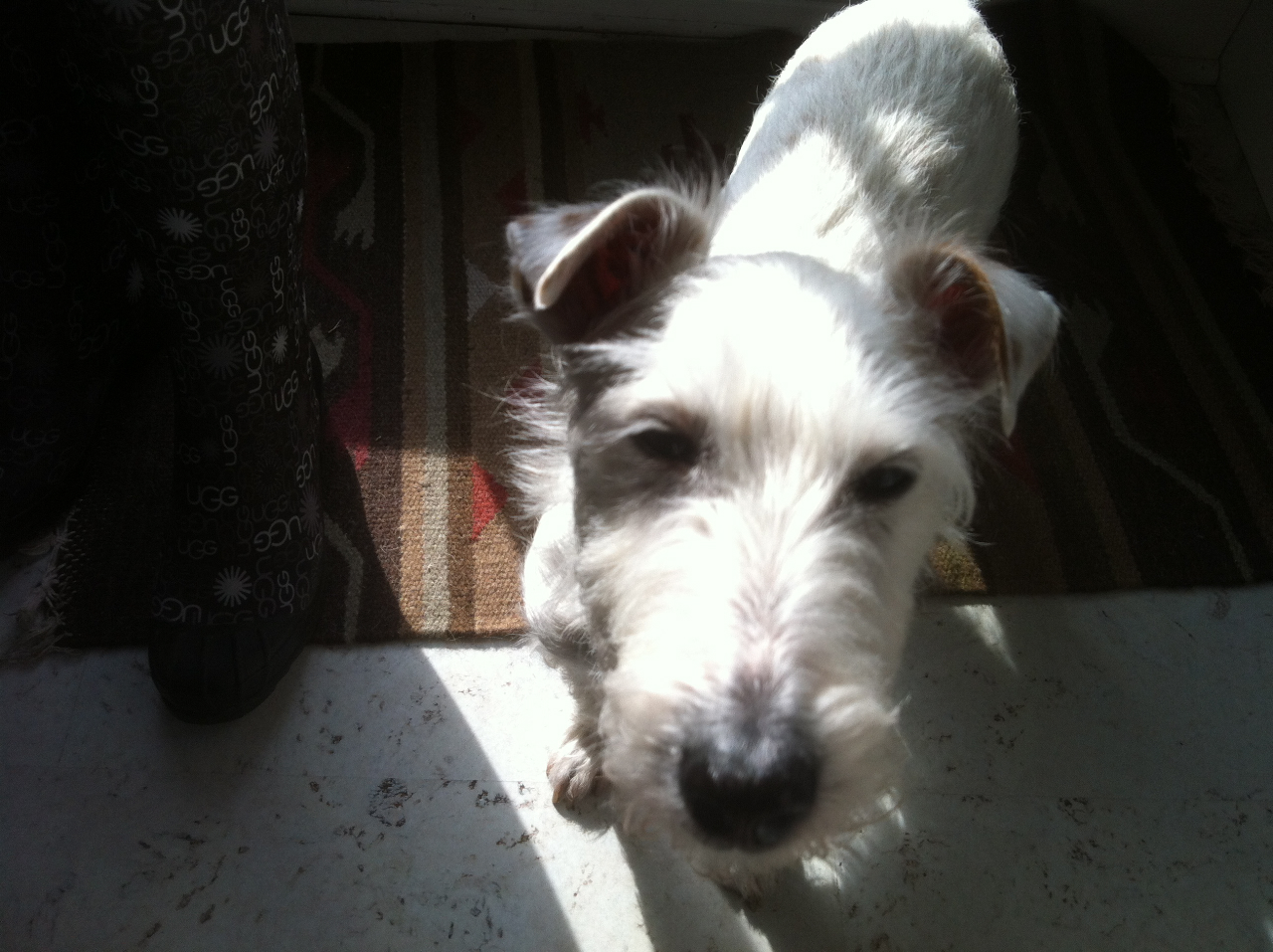
4:15: We arrive at the home of Heather Annis, another known clown. I accept the tea she offers. The subject has a beer. There is a small dog present – a common prop in clowning – but said dog is notably absent of the ruffled collar and cone hat I was expecting.
Not Pictured: Cone Hat and Ruffle
The subject tells me about the project I observed a meeting for that morning. I ask him why there are no clowns in it. He points out that it is possible to do more than one thing. This is very exciting news.
5:00 I leave for work.
Byron Laviolette is a Canadian director, dramaturg, writer and critic. In addition to working towards a PhD in Theatre at York University, he is also a co-creator of the Morro and Jasp series and is the lead narrative member on the Mission Business’ ZED.TO. He is also an excellent sport.
Sarah ‘Pip’ Bradford is the Mainspace Technician at Tarragon Theatre, the Youth Outreach Coordinator for the Toronto Fringe Festival, and the founder of Art Is Hard, a grassroots arts philanthropy project. She is also a noted lemur enthusiast. If you like what you see here, she blogs (infrequently) at The Christopher Pike Project, and posts daily to Tips From Pip, an unsolicited Tumblr advice blog. She has nine followers.
Welcome to my new video column for Praxis Theatre: 2 MINUTES WITH GRETA. You might remember me as the person behind an earlier series for Praxis called Celebrity Theatre. Now I am taking a more in depth look at the personalities who tread the boards of Toronto’s stages. For this first installment, I talk to Nina Lee Aquino on the set of SIA about being an Artistic Director, wearing different hats and what Toronto theatre needs.
Greta Papageorgiu is an actor, writer, teacher and director. She has performed extensively throughout Ontario and Quebec and was invited to teach in Munich, Germany last year. She loves the theatre and hopes to share some of it with you through 2 Minutes With Greta.
I’m a big fan of Harbourfront’s HATCH program, and the 2012 season begins this week with Mortified, a performance that “creates a sonic experience through movement and mayhem.”
Jenn Goodwin and Camilla Singh invited me into their jam session one morning late last month, and I was able to get a glimpse of their process as they rocked their drums for hours. Here’s a piece that reflects the work that I saw.
Shira Leuchter is an actor who also makes performance stuff and other art stuff. She co-stars in the short RUNG, which will be having its International Premiere at the Tribeca Film Festival later this month. She is an Associate Artist with UnSpun Theatre.
In his best-selling biography of Steve Jobs, Walter Isaacson details at length the Apple founder’s infamous reality distortion field—hisability to “bend any fact to fit the purpose at hand”. Isaacson recounts how Jobs used this knack for re-purposing the truth in order to dream up seemingly impossible products, but also as a way of restructuring past experiences in a way that best suited whatever current narrative he was in the process of spinning. In this way as in others, Steve Jobs was a storyteller—a practitioner of theatre. And over the past two weeks, we have received a powerful reminder that monologuist Mike Daisey, creator of the play The Agony and the Ecstasy of Steve Jobs, is as well.
As new evidence has shown, Daisey has been employing his own reality distortion field, and has bent many a fact to fit his purpose. (I won’t list the embellishments here, but they have been everywhere in the news; for those interested, I would highly recommend listening to the March 16 episode of This American Life, “Retraction”). For Daisey, the purpose at hand has been inspiring North Americans into demanding better labour conditions at the Chinese factories that manufacture our various electronics. And to this end, Daisey has achieved a real measure of success. The New York Times and many other major news organizations have taken up the fight and Apple’s Foxconn factory has become a household name. In response to these pressures Apple and Foxconn announced this past week, in a landmark admission of corporate culpability, that they will be implementing a massive overhaul of their labour practices, hiring more workers, eliminating illegal overtime and substantially improving the safety protocols in the factory. A direct line can be drawn between the growing profile of Daisey’s play, and the attention surrounding its cause.
Daisey’s ill-advised foray into journalistic territory—adapting his play for This American Life, appearing on various news outlets—has clouded the fact that he began by creating Agony as a piece of theatre, an art form in which invention is not only permissible, but kind of the point. When we attend a play, we are willingly offering ourselves up to be taken in, to suspend our disbelief, in order that we might connect to some underlying truth. This is exactly what Agony has done for its audiences. As host Ira Glass pinpointed during Daisey’s first appearance on This American Life a few months back, Daisey has done something “really kind amazing”, namely make people newly question an unjust system which on some level most of us have come to accept. “Which,” as Glass maintains “is really quite a trick, you really have to know how to tell a story to be able to pull something like that off.”
Knowing how to tell a story means something very different in the theatre than it does in journalism. Daisey has publicly regretted and apologized for his conflation of the two, and any damage that this may have caused, either to the cause or to the journalistic organizations whom he let take his words as fact. The uncomfortable question to consider is, had Daisey not included these fabrications, had his show just rested on the staggering statistics documenting the inhuman working conditions, without any of the what we now know to be the theatricalized moments, without the disfigured line worker apocryphally calling Daisey’s iPad “magic” or without the imagined gun-toting factory guards, would the same call to action have resulted? Would Apple and Foxconn have been driven to publicly vow to do better? Or would we all simply have tuned out these numbers, and relegated them to the statistical scrapheap in the back of our minds? Is this an instance where theatrical storytelling, more so than journalistic reporting, has been necessary in order to prompt change?
We’re interested in examining these questions, and so we will be continuing forward with our upcoming production of The Agony and the Ecstasy of Steve Jobs, adapting the show to engage with this new level of narrative complication. We hope that you will come see our show in May, and sift through these many layers of distorted reality, even as, like with any worthwhile piece of theatre, we attempt to catch you up in them.
Rough House Theatre's A Last Resort plays Friday and Saturday at 8PM
Friday and Saturday mark the final two days of Free Fall ’12 presented by The Theatre Centre in association with The Drake Hotel. Free Fall is a biennial national performance festival featuring new and boundary-testing works by emerging and established artists from across Canada co-curated by Theatre Centre AD Franco Boni and Praxis AD Michael Wheeler.
Mohawk/Tuscarora theatre artist Falen Johnson looks at the Queen and Ossington area from an Indigenous perspective. What was here before here was here? Who was here? And what’s still here? Come for a walk and explore the visibility/invisibility of the Indigenous history of the city of Toronto. You may be surprised where your feet land.
A Last Resort Fri Mar 30 and Sat Mar 31 @ 8PM
In 2004, Candelario Andrade left his home in Mexico and set off in search of a new life. In 2000, Camille Gingras returned to Canada as a last resort. A multimedia performance in English and Spanish, A Last Resort intimately explores the lengths two people will go for that perfect life just beyond the horizon.
Route #501 Revisited (v2 Public Streetcar) Sat Mar 31 @ 1PM
A tour of Queen Street, aboard a streetcar, conducted entirely via Twitter by @goldsbie via the hashtag #route501. As quiet and awkward as any TTC journey, yet immeasurably more fun. A rumble between the private and public spheres, as they uncomfortably rub up against each other and compete for your attention.
The Wooster Group image by Nancy Campbell - Click to enlarge
Guest post by Stephen O’Connell
Among producers of experimental theatre the Wooster Group is unique for its combination of aesthetic and political radicalism with intellectual rigor.
From the beginning, its work has been tough, difficult, vigorous and controversial. It has consistently addressed pressing social issues, including the victimization of women, racism, and the multifarious processes of dehumanization.
It has shocked and outraged a public inured to the unconventional and the daring.
It has brought into theatre material usually considered inappropriate, tasteless and illicit (including pornography, blackface and pirated text) not for sensational ends, but to explore and challenge middle-class culture, to question its assumptions and mode of operation and to reveal that which it has systematically suppressed.
It has made the New York theatre a vital arena in which social, political and cultural issues are debated.”
~ Breaking the Rules by David Savran
That description of the Wooster Group was published in 1986 and it is as true today as it was 26 years ago.
I first came in contact with the Wooster group 6 years ago when I first moved back to New York. I was keenly aware of their history and their controversial body of work. You could immediately recognize their overwhelming influence upon the independent theatre community in the city. At the ripe old age of 42 and already the co-artistic director of two successful Canadian theatre collectives(bluemouth inc. in Toronto and Radix Theatre in Vancouver) I contacted the performance garage, home to The Wooster Group and volunteered to be an intern. Despite my assumptions about my experience and level of expertise, I agreed to get coffee and pick up mail just like all the other recent college graduates interning there. In exchange I got to sit in on the company’s rehearsals and have an opportunity to watch their creative process first hand.
Two years later I was still interning at the garage, although I arbitrarily started referring to myself as an apprentice, because it somehow made me feel more useful. What I learned was not all useful or great, but definitely inspiring. I was disappointed to discover that the company did not function as collective as I had hoped. Several of the founding members had either moved on or had passed away, and the remaining company operated in more of a traditional theatre hierarchy than I had dreamed. Elizabeth LeCompte was basically the director at the helm, and I imagine the group dynamic may have been somewhat different in the earlier days.
The Wooster Group – VIEUX CARRÉ – director’s notes
What I did find was a room ignited with an explosive creative energy. The playfulness and pace of creation was like nothing I had experienced before. People were contributing and cutting ideas faster than I could keep up. I barely had a grasp of one image before the group had already moved on to three or more ideas ahead of me. I was dizzied by the incredible pace and amount of material generated. I had become so precious with my own ideas that I couldn’t imagine an atmosphere where good ideas were simply the currency that allowed you to remain in the room. At the garage you could work on an idea for over 2-3 months and it would easily be disregarded in a matter of seconds. I once spent 2 solid months erasing Richard Burton’s image from a film version of Hamlet, only to have it cut in an impulse, simply because the scene was too long. Then they would be on to the next thing. Layer upon layer, ideas are generated, recycled, trashed, confabulated, appropriated, exploded, ridiculed, deconstructed and then re-contextualized.
What you get is an onslaught of ideas and provocative images like nothing you had ever experienced before. I don’t always like what I see when I go see a Wooster show. One thing is for sure; you can’t help but have a strong opinion about it. To me that is the true test of relevant art.
The Wooster Group’s Version of Tennessee Williams’ Vieux Carré opens at World Stage on Wednesday.
Image of Stephen by Gord Hawkins
Stephen O’Connell is one of the artistic directors of the Toronto-based interdisciplinary theatre collective bluemouth inc. The company is a former resident company at The Theatre Centre, and Stephen was also co-curator with Franco Boni of Free Fall 2010. Next up for bluemouth is the return of the immersive theatre project Dance Marathon, May 18-19 at World Stage.
This week we were shocked to learn that The Vancouver Playhouse, a major institution in the national theatre ecology with a 49-year history, was closing its doors immediately effective Saturday night.
Some reactions from Vancouver & around the country:
Photo by Lois Dawson
The Globe & Mail’s Marsha Lederman covered the announcement here and the aftermath here
@SMLois arrived with her iPhone to capture the end of an evening vigil outside of the theatre, which she blogged about here
In backofthebook.ca, Frank Moher related the closure to a failure in Vancouver theatre criticism, among other factors
The Charlebois Post collected a series of responses from Canadian Theatre artists here
A response to assistance from the City by the Playhouse’s artistic managing director Max Riemer posted last September was getting heavy circulation on social media over the weekend
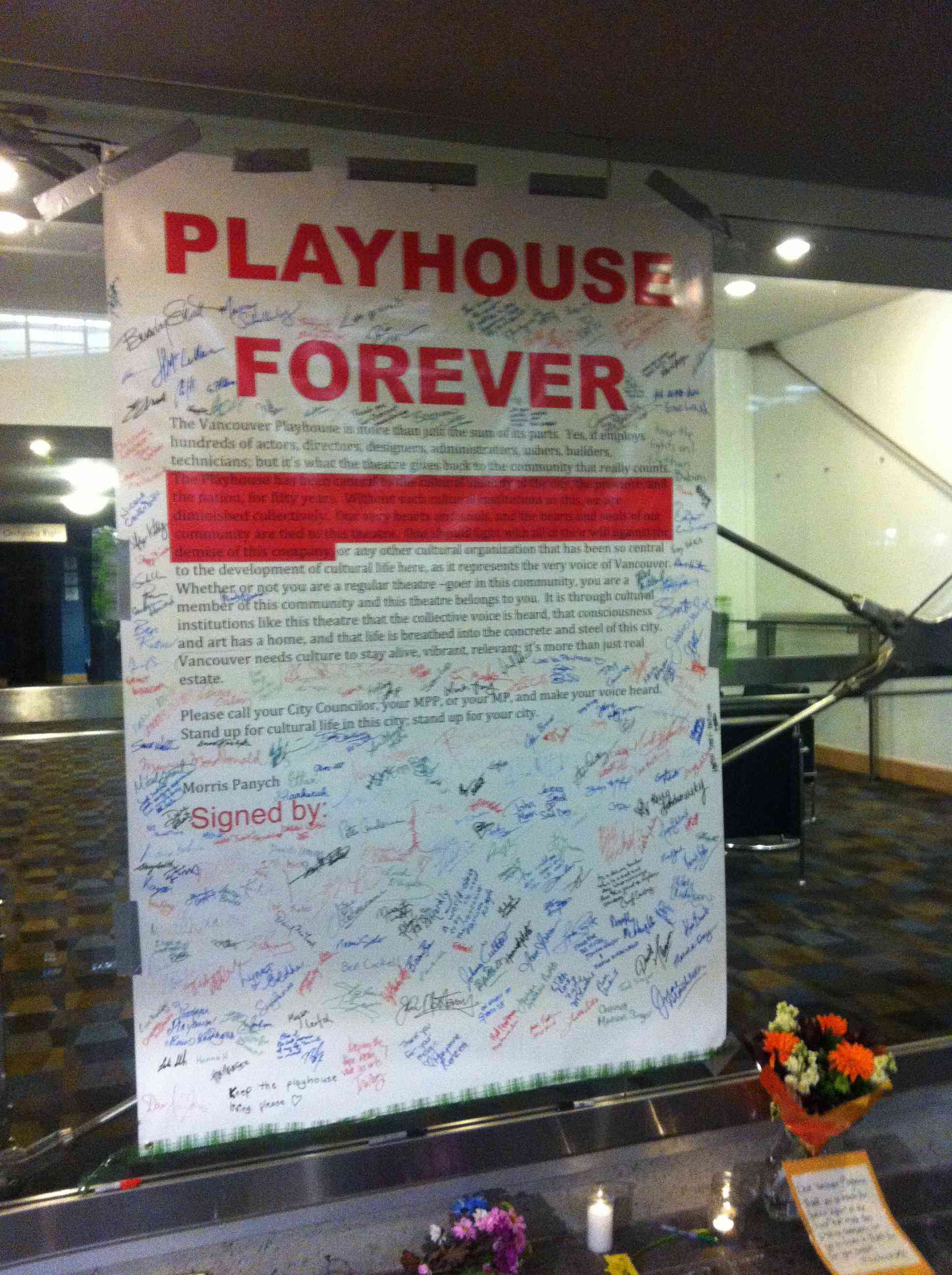
Below is playwright and director Morris Panych’s letter as it appeared at the theatre during the final performance transcribed by Lois Dawson:
The Vancouver Playhouse is more than just the sum of its parts. Yes, it employs hundreds of actors, directors, designers, administrators, ushers, builders, technicians; but it’s what the theatre gives back to the community that really counts.
The Playhouse has been central to the cultural identity of the city, the province, and the nation, for fifty years. Without such cultural institutions as this, we are diminished collectively. Our very hearts and souls and the hearts and souls of our community are tied to this theatre. One should fight with all of the demise of this company or any other cultural organization that has been so central to the development of cultural life here, as it represents the very voice of Vancouver.
Whether or not you are a regular theatre-goer in this community, you are a member of this community and this theatre belongs to you. It is through cultural institutions like this theatre that the collective voice is heard, that consciousness and art has a home and that life is breathed into the concrete and steal of this city. Vancouver needs culture to stay alive, vibrant, relevant; it’s more than just real estate.
Please call your City Councillor, your MPP, or your MP, and make your voice heard. Stand up for cultural life in this city; stand up for your city.
“I begin with the etymology of ‘settler’ as a thing or person that settles, within the etymology of ‘settle’ as a thing or person that ‘comes to rest,’ that establishes a ‘permanent residence.’ But ‘settle’ also belongs etymologically to ‘reconcile’ or “reconciliation,’ which in turn belongs to ‘bring together’ (again), to ‘make friendly, and to make consistent.’”
Last night, the Canadian Actors’ Equity Association held it’s Annual General Meeting. At that meeting, a Member’s Resolution was put forward by director, playwright and independent theatre artist Ed Roy:
WHEREAS Equity Member/Creators have demanded action on indie theatre issues for the last three years, expressed in the form of member resolutions at previous National AGMs, which resolutions passed 96-1 in February 2009, and 42-4 in October 2009;
AND WHEREAS the Independent Theatre Review Committee (ITRC) was formed in response to the demand for action on indie theatre issues and completed its work in September 2011;
AND WHEREAS the suggested policy changes resulting from the ITRC’s work on indie theatre issues have been debated and will soon be put in place by Council;
BE IT RESOLVED that Council require the Executive Director to deliver a plan that will directly address indie issues to CAEA members that will finally address indie theatre issues no later than October 31, 2012.
BE IT FURTHER RESOLVED that should the Executive Director fail to deliver a new indie plan to CAEA members by October 31 2012, then until such time as this new indie plan is delivered, that Council enact policy to enable members to work under any currently existing CAEA agreement, policy or guideline (with the exception of engagements governed by a negotiated agreement) as such individual member deems appropriate including the Festival Policy, the Guest Artist Policy, the “Indie” Policy, the Small Scale Theatre Addendum or Co-op Guidelines, without CAEA staff approval and without CAEA penalty or repercussion.
The motion was voted on, with more than two thirds of those in attendance voting in favour.
We have written previously on the issues of Equity and the work of indie theatre artists here and here, and very much look forward to seeing a new indie agreement that reflects the results of the Independent Theatre Review Committee survey, which can be viewed here.
Both the ITRC and Council have devoted a great deal of time and energy to this initiative. It is now in the hands of the Executive Director to deliver new agreements by the October 31st deadline. After four years of members bringing this issue forward and making it a priority, this is a very positive step for Equity.
Last November we wrote about a Canadian Actors’ Equity Association Meeting and why, as independent theatre artists, it was important for you to attend.
On Monday, February 27th, the CAEA is holding its next Annual General Meeting. Given that little has changed for independent artists since we wrote our last post on the issue (or since we published “Why Canadian Actors’ Equity Association is important and why it has to change” in May of 2010), it is essential for artists who are members in good standing to attend this meeting and support each other on Monday night.
Here’s what you need to know, and what you need to pass along to all of your friends who are members of CAEA:
Who: CAEA Members in good standing (bring your membership cards!) What: CAEA’s Annual General Meeting When: February 27, 2012, 7pm (doors open at 6:30pm) Where: Gladstone Hotel (Ballroom) – 1214 Queen Street West, Toronto, ON Why: To support the efforts of independent theatre artists creating new work across Canada
We’ve heard there will be a mixer party after the meeting, so there’s another reason for you to attend!
“After the years and years of weaker and waterier imitations, we now find ourselves rejecting the very notion of a holy stage. It is not the fault of the holy that it has become a middle-class weapon to keep the children good.”


 Sarah ‘Pip’ Bradford is the Mainspace Technician at Tarragon Theatre, the Youth Outreach Coordinator for the Toronto Fringe Festival, and the founder of Art Is Hard, a grassroots arts philanthropy project. She is also a noted lemur enthusiast. If you like what you see here, she blogs (infrequently) at The Christopher Pike Project, and posts daily to Tips From Pip, an unsolicited Tumblr advice blog. She has nine followers.







Recent Comments