Soulpepper is number one in Toronto theatre in private fundraising as a percentage of revenue (blue).*
by Lindsay Schwietz
Artists have always had issues with finding ways to finance their projects and support themselves. With the Toronto Arts Council reporting the average earnings of Canadian artists to be $23,500* (the lowest 25th percentile of average earnings and hardly an amount to live comfortably by in Toronto), theatres and theatre artists are continually seeking funding through the government, trying to increase their ticket sales and find private donors to support their art.
Soulpepper theatre has created a unique way of dealing with this – the Soul Circle Mentor program. For a donation of over $20,000, a donor can become a “philanthropic mentor” to one of the artists in the Soulpepper Academy. “We wanted to find a way for donors to have more of a one-on-one connection,” says Juniper Locilento, the Government Relations and Foundations Manager of Soulpepper. “So the Soul Circle Mentor program came into existence when the Academy started in 2006. We really saw it as an opportunity, on a bunch of different levels, for some of the donors who are closest to us, to give them an opportunity to connect more closely with these artists who were coming in. And we wanted to give these artists an opportunity to interface and network and just talk to donors so they would become a little more comfortable with that idea.”
The Soulpepper Academy is a group of ten artists (directors, playwrights, designers and performers) chosen from across the country to develop their skills in a two-year fulltime paid residency program at Soulpepper. The first year of the program focuses on training and teaching, with the second year focusing on performance and production. The artists not only get a chance to work with the Soulpepper Company on the mainstage, they also develop a collective creation, which is performed at the end of their two years.
For Mike Ross, being paired with the Youngs meant Raptors tickets, dinners in Rosedale, performing at a birthday party for their parents, and finding backers for his one man show. Photo by Sandy Nicholson
As a major part of their training they are each paired with one artistic member (usually a Soulpepper founding member) and a philanthropic mentor (in most cases a wealthy business couple) by Albert Schultz, the Artistic Director of Soulpepper. The Academy members are required to forge a relationship with the philanthropic mentors they are paired with. This includes talking to them at functions, wine and cheese at pre-openings, dinners together, and sitting with them on opening night –at least once a month, but potentially three or four times a month.
“It was our responsibility to forge a relationship with these people, as it was theirs as well,” says Mike Ross, a graduate of the Soulpepper Academy and a current Associate Artist at Soulpepper. “We were expected to spend time with them. It was actually something that was a little intimidating at first because, although everybody’s there for the same reason, it’s different kinds of people – the artists and often time business-world people. It’s not easy to walk up to someone like that cold and start getting to know them.”
After two years, though, they get over this awkwardness. For Mike Ross, he became friends with his mentors – David and Robin Young of the Young Centre. “We’ve developed enough of a relationship that Soulpepper this season is producing a one man show of mine that they’re the private sponsors for specifically,” he says. “It became a surprisingly casual relationship.”
“I would be very nervous, if it wasn’t for my experience here, going up to what, at that point, I would have deemed just a rich person and asking them for money. I don’t feel that’s the case anymore – I’m asking them to create a relationship, which is a different thing. That’s for them something we can share in. It’s not just handing your chequebook over and maybe giving a shout out on opening night. We’re going to be part of something all together and all get something out of it.”
Soulpepper is thriving. With only 10% of their over 8 million dollar a year revenue coming from government funding, they have obviously found a way to create a sustainable theatre company through their network of private donors – without using tax dollars. They have made relationships with these people who have money to donate and made them part of theatre –made them invested in the arts on a monetary, personal and emotional level. They are teaching developing artists the skills to be able to schmooze and develop relationships with donors and learn the art of theatre as a business.
With Soulpepper it works. They produce classical plays that are generally audience-friendly, with well-known Canadian actors and theatre artists. With plays by Tom Stoppard, David Mamet and Edward Albee, starring actors like Eric Peterson straight from his success on Corner Gas, it’s an easier sell to people outside the theatre community than other companies producing new creations.
But can this model work elsewhere? What about those artists who don’t want to produce classical audience-friendly theatre? Would a business-minded couple be interested in supporting political or experimental theatre?
Mike Ross had a great opportunity to be paired with David and Robin Young, who are devoted and involved with the company. But this method of fundraising raises new questions about creative support: What about those Academy members who are paired with less enthusiastic mentors? What if they don’t get along? What would happen to a student who offended a donor? Or does Soulpepper already ensure that won’t happen by choosing artists that certainly wouldn’t offend donors?
Theatre is created when there is the capital available to create it. There is constantly a struggle to reconcile the need to create art that artists believe in, with the need to finance that art. This isn’t a new problem. Finding money for theatre projects and adapting the product to get that funding is a problem that has been around a very long time. Moliere, Stanislavsky and Shakespeare all forged personal relationships with wealthy elites to facilitate their art.
So this certainly isn’t a black and white issue. One one hand it begs the question, “Has Soulpepper taken the model too far for 21st Century sensibilities? Are they influencing young artists to focus on the sell-ability of their creations over developing new riskier works? It would be simplistic to stop there however, considering the other two major resources for creating theatre: grants and ticket sales. The sad state of arts funding for independent artists in Canada combined with recession-era entertainment budgets leaves few alternatives. Perhaps creating art is living with a series of compromises.
* Data courtesy of theatres and/or the charitable section of the CRA website.
1 Last year the Festival got a lot of press with some controversial YouTube videos you produced. Is that the strategy this time round?
The strategy is to be provocative and playful. The controversy last year was great, as it attracted a lot of people to the blog, and started a really compelling debate. The intent, however, was not to be controversial, but to be playful and provocative. I’m a big believer in provocation… I like taking questions I have and turning them on their ass a bit. This theatre community needs to be braver. We’re all much too precious, in my opinon. We take ourselves VERY seriously, and attach a certain preciousness to what we are doing that is often standing in the way of creating an HONEST dialogue about real things. There is too much bullshit, if you ask me. Too much talking AROUND issues. If we want people to actually give a shit about theatre, we have to start making work that people actually give a shit about. That doesn’t happen often enough. We spend too much time trying to please each other, than ask each other to have legitimate thoughts and feelings about things. We’re too afraid of being disliked–as if being LIKED should ever be the goal. How about making something INTERESTING?
2 This year your first video about a “Typical Canadian Play” pokes fun in particular at art councils for supporting queer and First Nations oriented material. Was there any intention to tie this message to the critique you made of the Dora jury system on the Globe and Mail website the day after Agokwe swept the Doras?
The intent was not to poke fun at art councils, but to poke fun at Canada. Its no secret that we, in Canada, put a lot of effort into supporting ideas of diversity. You may have interpreted the video as poking fun at Arts Councils, but really, the joke was about a white man trying to appropriate as many cultures as possible to try and get some money from an arts council. Personally, I happen to think its very important that there is support and continued development of voices from as many cultures as possible. I don’t happen to think we do a very good job at it, mostly because we’re too afraid of NOT supporting diverse cultures, that we often throw money to anything resembling diversity. And so, I happen to think the idea of using diversity as a ploy to get arts council money is very funny. I’m not blaming anyone in particular… I’m just interested in trying to get conversations that we’re not having, going. Anand Rajaram has written a really great piece about this in our upcoming issue of WORKS.
My critique of the Dora Jury system had nothing to do with First Nations culture, and everything to do with mediocrity. Kelly Nestruck questioned why Agokwe got as many nominations as it had despite his belief that it was mediocre. And so I explained how, often, mediocre work will get a lot of attention at the Doras because of the specific points sytem the doras use. I think it is flawed, and I also think there should be more than 10 jurors, and I think there should be criteria for the jurors. If we ever want to take the Doras seriously, there should be a lot more thought put into how decisions are being made. I understand, though, that this is difficult given that Jurors are donating their time.
Also, my critique was prior to Agokwe sweeping the doras, not the day after.
Alon Nashman, NOW Magazine’s top theatre artist of 2008, stars in the first video promoting this year’s SummerWorks Festival.
3 What’s up with the small animal theme to the SummerWorks brand?
They are Toronto’s downtown animals — squirrels, racoons, pigeons and skunks. They are often given a bad rap, and so we thought it would be nice to throw some love their way. We’ve also given them sashes, turning them into a sort of beauty pageant contestants. The irony makes me happy. The design is also pretty. I think they’re all kind of cute. A re-contextualization of “pests”.
4 Canadian Actors’ Equity Association is working on a new agreement they say will be more responsive to membership taking place in festival like SummerWorks. Have they contacted you for any feedback or input? Have you heard about them asking anyone for input? What would you like to see in it?
No, CAEA only gets in touch with us when they want to make sure we are not breaking any rules. I would love it if they asked for our input. I would also love to see CAEA having a universal agreement that would let people produce their work under any name, despite their history, at the festival, without having to jump through hoops. To be honest, though, I’ve never really had a problem with equity when I was producing at SummerWorks in the past … when writing to Equity they didn’t really offer me any answers except for that individual companies should be contacting equity themselves.
5 Going into your second full year as Artistic Producer of SummerWorks, what is the one thing you wish wasn’t part of your job description?
Having to be both the Artistic Director and General Manager, with not enough money for myself or my staff.
The SummerWorks Festival runs August 6 -16th.
It has a great website here. And a cool blog here.
Peggy Pickit Sees the Face of God – Maev Beaty and Tony Nappo #1
This post is the first of several discussions that took place over email between Africa Trilogy actors Maev Beaty and Tony Nappo. Click here to read the introduction to Peggy Pickit Sees the Face of God.
The Human Problem of “What Do I Do?”
Maev:
Mr. Nappo, a pleasure to be having this “e-discussion” with you. Let me ask the first question…we’ll start light. We’ve done two workshops of this play now…has your perspective on the West’s relationship to Africa changed?
Tony:
I am not sure whether or not my perspective has changed. It’s just expanded, I suppose. I think at the heart of this play, there seems to be some kind of statement about our choices as human beings to get involved or not in any kind of human crisis. Are we obligated morally to help if we can, and will our help, ultimately, make any difference at all after a crisis reaches a certain point-and, at what cost to us as the individual?
It makes me think, historically, about the Holocaust and, contemporarily, about the Tamils. It seems that people want such atrocities to stop or never to have existed, and rightfully so, of course, but the natural instinct to survive and self preserve would dictate that one doesn’t actually physically get involved which becomes easier the farther removed, geographically, one may be from any given situation. So is desire for change strong enough to create a pull towards action?
It’s one thing to be appalled by what is happening and quite another thing to do something about it when something isn’t directly affecting your day to day. Like Bono sings in that Christmas song- “Well, tonight thank God it’s them instead of you.” That is one of the truest, saddest lines ever sung. And that sadness seems to permeate Roland’s piece. So, I am thinking, and answering, I guess, in more human terms than factual or political terms. But I am playing Frank, who makes the choice not to help but live his own life- as the actress playing Carol, you must have had to search for the part of yourself that would go- would have to go and at least try to make some difference. What surprised you or didn’t about yourself in this regard?
Maev:
Yes, Carol is a puzzle, as far as the original impetus (or courage?) to go and ‘help,’ but now it seems she’s left with a dismal sense of futility and loss and, I sense, some resentment. It reminds me of a book that Josette mentioned in our Glo workshop which I am now eager to read titled Dead Aid: Why Aid Is Not Working and How There Is A Better Way for Africa. I here confess that I had, of course, heard arguments that aid was not getting to where it needed to go and that it was often sucked up in corruption. But I had always, in my gut, believed it must still be ‘helping.’ From what I’ve read about the book, the author claims aid has made things much worse on the continent.
Carol’s journey feels a bit resonant of this (particularly in relation to Annie – and theatrically, Annie as a metaphor. Did she, in fact, exacerbate the cruelty of Annie’s circumstances?) This relates to the human problem of “what do I do?” And of course, this is theatre, so we are only going to ask lots of questions – not provide answers. But I DO think A3 has a responsibility to open up the questions to everybody. I’m really hoping there will be a way for audiences to immediately (like, in the lobby) respond to the work, ideally on computer (who even remembers how to write with pencil and paper anymore?), with live posting capability. And I hope there will be lots of resources available for some ongoing relationship/dialogue to the issue.
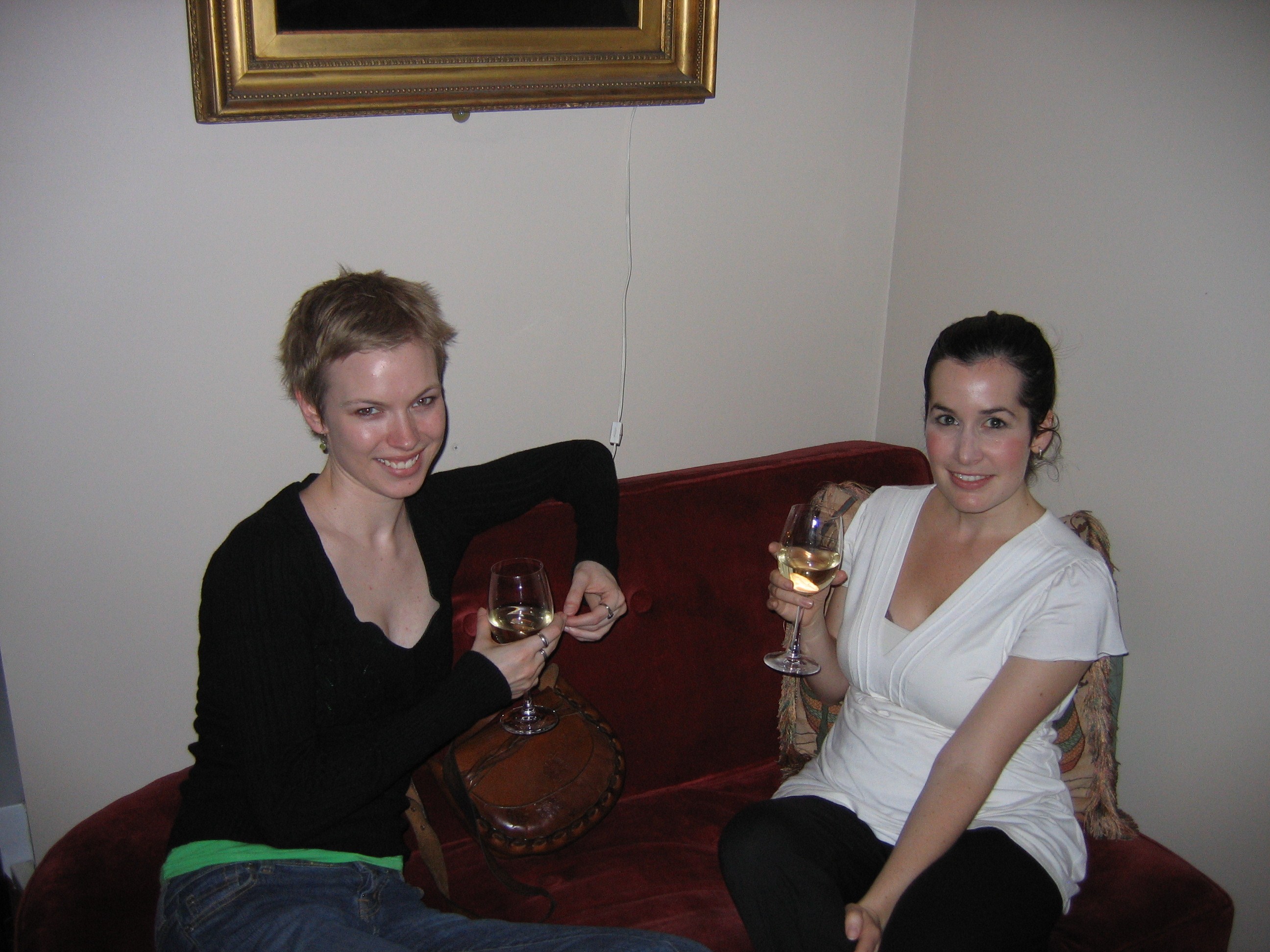
Christine Horne star of Praxis Theatre Summerworks production Underneath (left), with Amy Lee star of the Fringe hit Moro and Jasp do Puberty
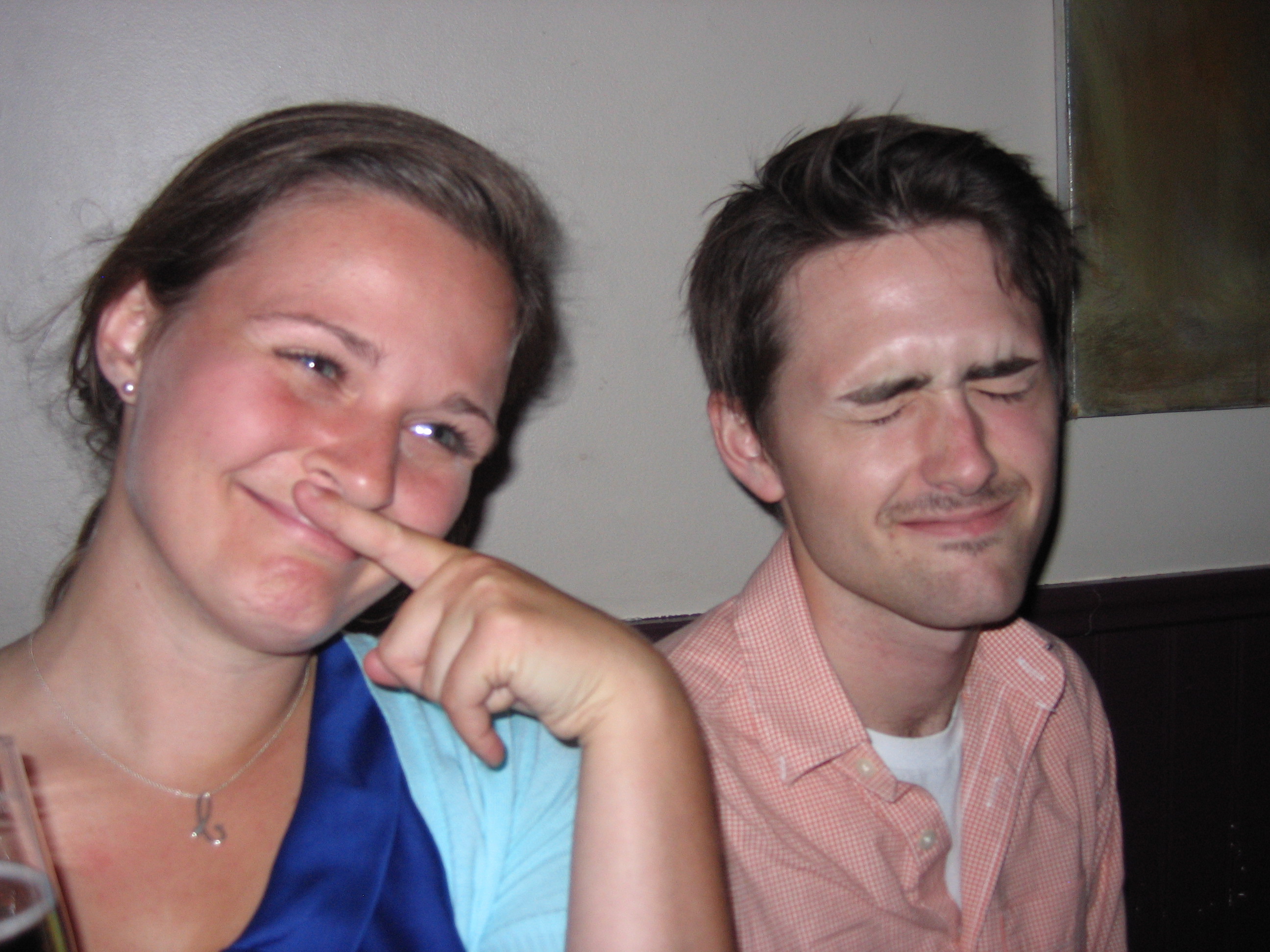
Tim Buck 2 comrades Brittney Filek-Gibson and Ben Sanders battle to see who can have a more ridiculous moustache
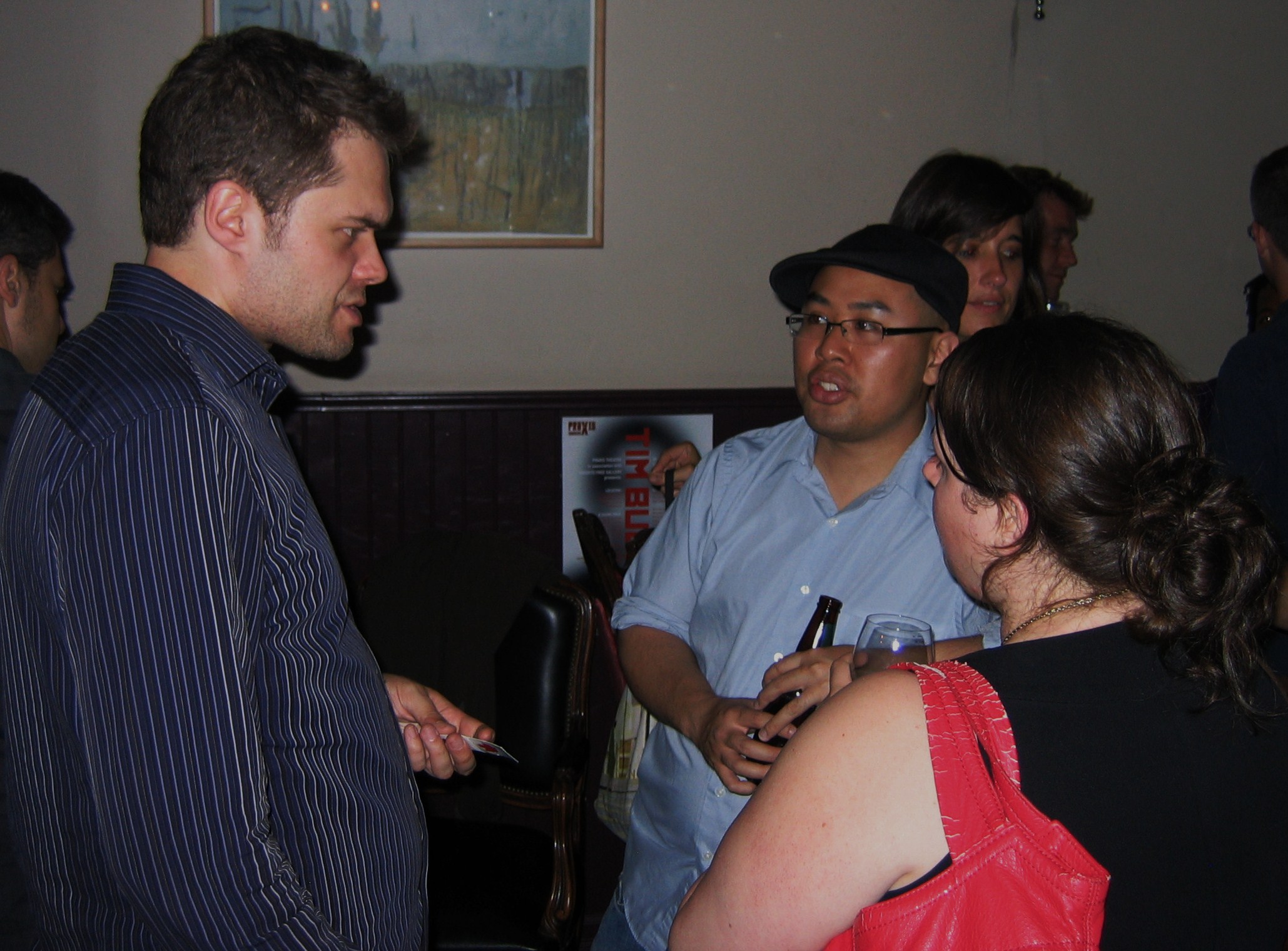
Praxis Theatre Co-AD Simon Rice (left), talks to Underneath Sound Designer Wesley Cheang and Praxis Production Manager Meredith Scott
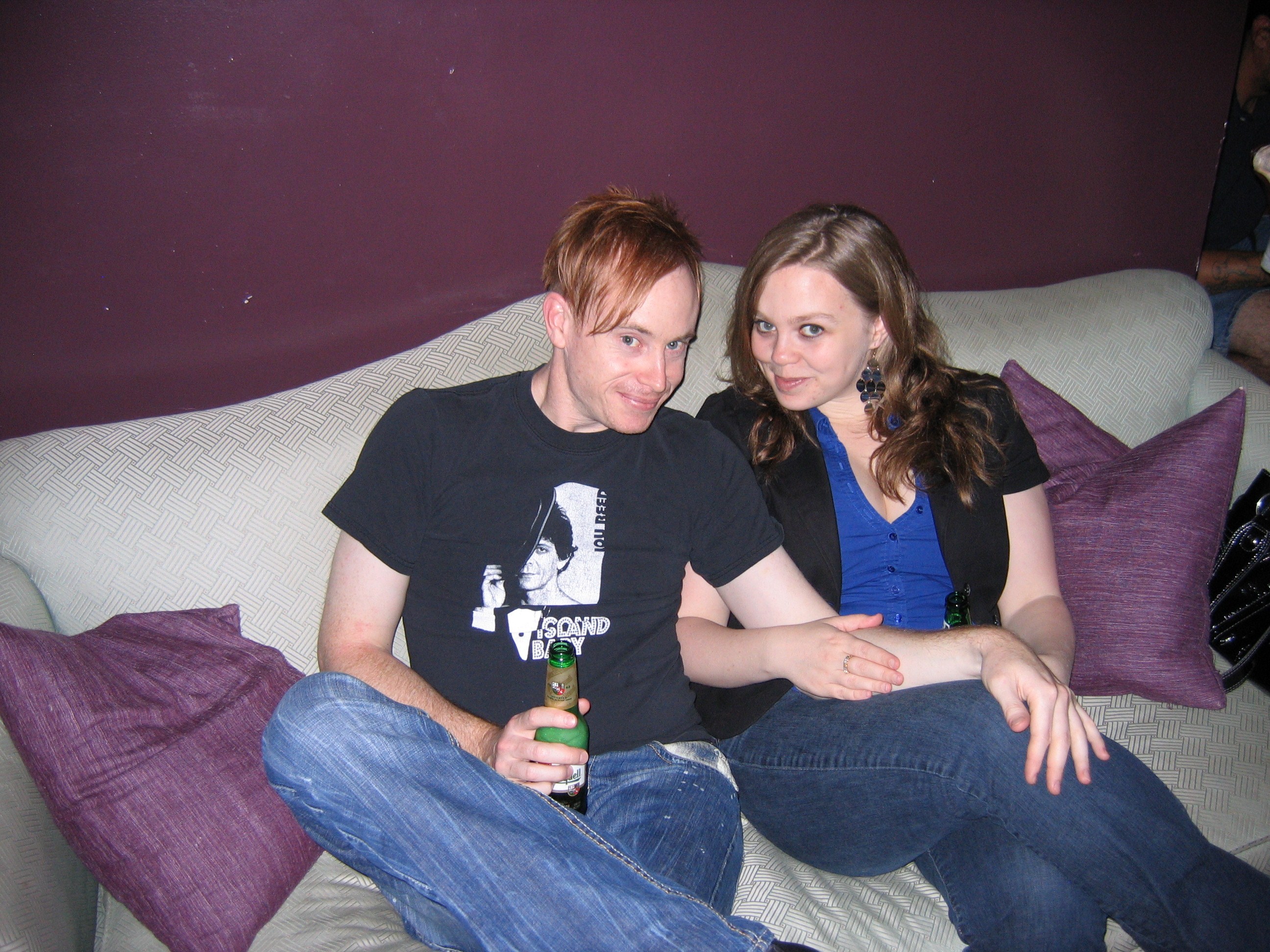
Michael Sullivan with Tim Buck 2 Script Coordinator and director of Fringe hit Rock Time 2009, Aislinn Rose
Praxis Theatre Co-AD Michael Wheeler and GM/Performer Margaret Evans
Thanks to everyone who came out and made this event a huge success.
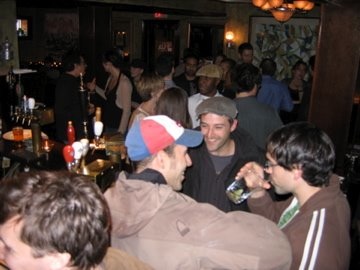
We must be getting older: Our earliest such events in 2003 and 2004 were heavily beer and shooter based affairs. There was a noticeable rise in decent wines and single malt scotches this time around.
The Circle of Life, so it goes…..
P.S. It’s not too early to book your tickets to Underneath,opening August 7th at The Factory Theatre.
Peggy Pickit Sees the Face of God – Roland Schimmelpfennig
As the Africa Trilogy Series continues, there will be a number of conversations between Maev Beaty and Tony Nappo, two actors who have been involved in the project from the intial workshop in 2008. To have a full understanding of what they will be writing about, this post describes the show they have both been working on, Peggy Pickit Sees The Face of God, and some ideas from the playwright, Germany’s incomparable Roland Schimmelpfennig.
The Story:
Set in an unidentified Western city, Peggy Pickit begins with a white married couple arriving at another white couple’s house for a reunion. All four were best friends at medical school. All are now 41. Two have just returned from crisis work in Africa –escaping a particularly violent flare-up. They have been gone for six years. The other two stayed at home, had a child, and made a lot of money. Each couple looks at the other with envy. Both marriages are in trouble. The returning couple left behind a local child in Africa that the other couple was sponsoring. The fate of that child is unknown, but we learn she is dependent on drug therapy, and without treatment, she will likely die.
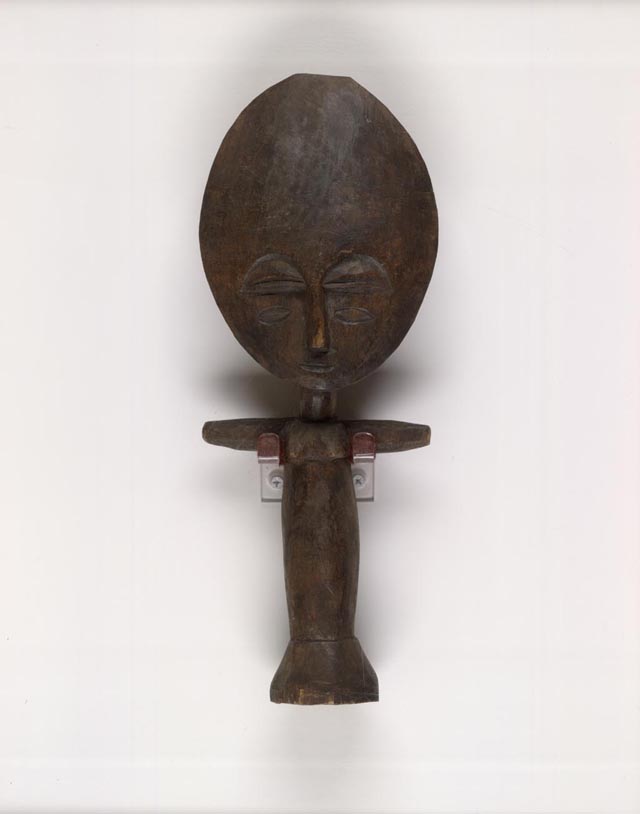
The evening turns into a post-colonial version of Who’s Afraid of Virginia Woolf . Accusations, pain, anguish and bitter comedy are used to explore damage/guilt in the West. The title refers to a small plastic doll intended as a gift for the African child – a child whose only representation on stage is a small wooden carving.
Says Schimmelpfennig:
There are things that are too big, too cruel, too complicated to be transformed into dramatic art.
There seems to be almost no acceptable way to show the disaster of AIDS in Africa on a theatre stage. But I am sure there is one, and I have tried to find it.
The focus of dramatic art is always on the human being. Theatre deals with people. Theatre is not that good at dealing with theory or with global economic structures. Theatre is good at giving these things a name and a human face. In the first draft of the play I am writing for the project, it is the face of a little girl. Or the faces of two little girls: Annie living in an unidentified African village, and Kathie, living in an unidentified Western city. We see these girls – but only through the lens of four Western adults grappling with impossible decisions, and through the figurines these girls play with.
From my personal point of view, as a writer (as far as I can say it by now), this subject needs a very clear and striking transfer to a western context. And that is why I want to write the play and take part in the project.
In the end there will be three points of view on a more than complex matter – as far as the writers are concerned. More creative minds will be involved: directors, actors and others. The result of all these people’s effort will be a rare and powerful experience. It will link people. It will raise attention.
This year, for the first time The Best of The Fringe will be at The Berkeley Street Theatre with the support on The Canadian Stage Company and NOW Magazine. Big step up from the old Diesel Theatre stand up comedy chamber that used to host these post-Fringe hits!
Hipcheck – The Musical
Book by Shelley M. Hobbs, Music by Rob Torr; Lyrics by Shelley M. Hobbs and Rob Torr
UPSTAIRS AT BERKELEY: Friday July 17 – 7pm · Saturday July 18 – 7pm · Wednesday July 22 – 9pm
My Mother’s Lesbian Jewish Wiccan Wedding
By David Hein and Irene Carl
UPSTAIRS AT BERKELEY: Wednesday July 15 – 9pm · Thursday July 16 – 7pm · Friday July 17 – 9pm
Politically Correct Bedtime Stories
Based on the Book by James Finn Garner; Adapted by Jessica Beaulieu
UPSTAIRS AT BERKELEY: Wednesday July 15 – 7pm · Thursday July 16 – 9pm · Saturday July 18 – 9pm
Head First
Choreography By: Holly Treddenick and Sabrina Pringle
BERKELEY MAINSTAGE: Thursday July 23 – 9pm · Friday July 24 – 9pm · Saturday July 25 – 9pm
As You Puppet
By William Shakespeare and adapted by Hank’s Toy Box Theatre
UPSTAIRS AT BERKELEY: Thursday July 23 – 7pm · Friday July 24 – 7pm · Saturday July 25 – 7pm
A Singularity of Being
By T. Berto
BERKELEY MAINSTAGE: Thursday July 23 – 7pm · Friday July 24 – 7pm · Saturday July 25 – 7pm
Morro and Jasp Do Puberty
Written and Performed by Heather Marie Annis and Amy Lee
UPSTAIRS AT BERKELEY: Wednesday July 22 – 7pm · Thursday July 23 – 9pm · Friday July 24 – 9pm · Saturday July 25 – 9pm
Tickets are $16.50 each and are available starting July 14, 2009
416.368.3110 or www.canstage.com.
The Berkeley Street Theatre – 26 Berkeley St.
Were you at this performance? Let us know your thoughts and feedback. Hopefully this is the first stage of development for this project and we’d like to know what you thought.
Were you at this performance? Let us know your thoughts and feedback. Hopefully this is the first stage of development for this project and we’d like to know what you thought.
“After the years and years of weaker and waterier imitations, we now find ourselves rejecting the very notion of a holy stage. It is not the fault of the holy that it has become a middle-class weapon to keep the children good.”









Recent Comments